Three Months After the 8 August Split: The Chains, the Clients and the Argument Over Data
A dispute over how much non-payment data a transaction may carry divided one block history on 8 August into a SHA-256d chain that Bitcoin Core follows and a chain that, from block 961640 on 30 August, runs on BLAKE2b and that Bitcoin Knots follows. Each side in its own words, and what the record shows.
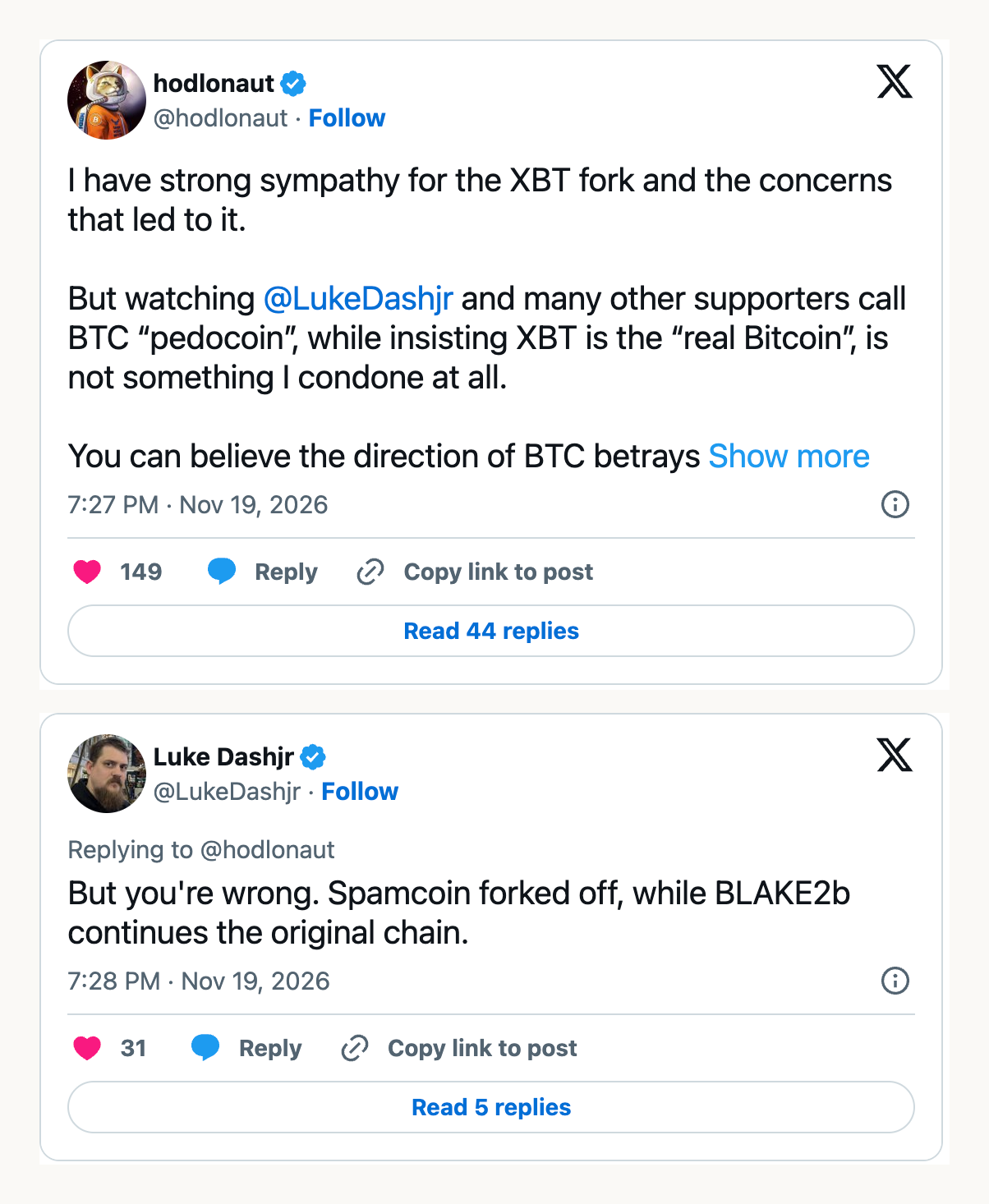
On 19 November, three months after the split, two people who share many of the BLAKE2b chain's concerns argued in public over what that chain is. "I have strong sympathy for the XBT fork and the concerns that led to it," hodlonaut, a long-time bitcoin advocate, wrote on X at 16:27 UTC, using a name some of the chain's supporters give its coin. But he wrote that he did not condone Luke Dashjr and other supporters calling BTC “pedocoin” while insisting XBT is the “real Bitcoin”, and that his biggest concern was "the risk of people believing they’re buying Bitcoin when they’re buying a different asset".106
Luke Dashjr, the lead maintainer of Bitcoin Knots, answered a minute later: "Spamcoin forked off, while BLAKE2b continues the original chain."107 "BLAKE2b is not a different asset. It is the same one continuous for 17 years."108 hodlonaut asked: "In a decentralized system, should there be room for difference of opinions?"109 Luke Dashjr replied that "20% of the network does not get to redefine Bitcoin to Spamcoin against the protest of another 20%."110 hodlonaut answered that "The overwhelming majority of the market recognizes BTC as Bitcoin", and that Luke Dashjr was "treating your interpretation of Bitcoin's continuity and identity as an objective fact that everyone else must accept."111 Luke Dashjr called the market claim "not a documented fact, but a guess based on widespread fraud".112 Each treats his reading of the chain's identity as settled; the rest of this Story sets out what each chain and each client has done since August.
Method
Captured from X's own embed view of each post (platform.twitter.com), which shows no account's own state, on 19 November 2026; the two posts are stacked unaltered.
The two chains share their history to height 961631. The SHA-256d chain applies the rules Bitcoin Core applied before BIP 110's signalling window. The BLAKE2b chain applies the rules of BIP 110 and, from block 961640, BLAKE2b proof of work. Each side calls its own chain Bitcoin; the Gazette names them by their proof of work.1353
What happened
BIP 110, the Reduced Data Temporary Softfork (RDTS), is a Bitcoin Improvement Proposal by Dathon Ohm that credits "Original draft and advice: Luke-Jr". A soft fork tightens the rules, so nodes that have not upgraded still accept the new blocks; a hard fork loosens or changes them, so those nodes do not. For about a year BIP 110 makes a block invalid if a transaction in it creates an output script over 34 bytes (an OP_RETURN data output may have 83), carries a data push or script argument over 256 bytes, or uses certain script features, among them taproot scripts that execute OP_IF. Coins created before activation are exempt. Miners signal by setting a bit in the block header, and from height 961632 to 963647, the mandatory signalling window, "blocks that do not signal bit 4 are rejected as invalid."01 Merged on 7 February 202654, it shipped as an option in Knots 29.3 on 9 May.12
It answered Bitcoin Core 30.0 of 10 October 2025, which raised the default amount of OP_RETURN data a node relays and puts in its blocks to 100,000 bytes, "which effectively uncaps the limit"; operators can set it back to 83, and blocks carrying more were already valid.02 Sixteen days later Dathon Ohm wrote on the developers' mailing list: "Due to Bitcoin Core v30 gaining in popularity, it has become necessary to move forward"; the idea was "to strongly re-affirm in consensus that bitcoin is money, not data storage."04
Each chain has its own block 961632. In the 2,016 blocks before the window, 51 set bit 4, all labelled OCEAN by mempool.space; 1,109 were needed to lock BIP 110 in early. On the chain Core follows, none of the 2,016 blocks in the window set it; its 961632, labelled AntPool, carries 19:35:55 UTC on 8 August.05 On the BNOC monitoring forum the developer b10c's timeline puts the other 961632 at 20:12 UTC: "BIP-110 miners found a signaling block 961632. This forked the chain."06 mempool.guide labels the BIP 110 branch's first eight blocks, 961632 to 961639, still mined with SHA-256d, OCEAN; the last carries 28 August.07 Mark Artymko, OCEAN's president, told the Gazette by email on 20 November that all eight were mined by the Roughnecks, "a group of BIP-110 supporters who rented hashrate", who built their own block templates with their own node and DATUM gateway and used OCEAN's separate reward-sharing setup for that branch: "None of the eight blocks used templates from an OCEAN-operated Stratum endpoint." OCEAN did not pay out rewards on that branch, he wrote: "The SHA-256 branch stalled at block 961,639 before any of the eight block rewards reached the required 100-block maturity. Those rewards could not be spent on that chain." The Roughnecks announced on 9 August that they would stop, and on 10 August that they would "resume mining ASAP": "We will continue mining until a sensible POW change can be implemented to replace the centralized mining pools that left".5556 The branch's next block, 961634, carries 12 August.07
OCEAN said on 10 August that for "roughly 18 hours" some miners using its templates "may have believed they were mining on the non-BIP-110 chain" while their hashrate went to the BIP 110 chain, and that it would pay affected miners a rebate of about 0.3 BTC.08 Artymko wrote that for about 18 hours after the split OCEAN's default Stratum endpoint still directed hashrate to the BIP 110 branch, and that because OCEAN "couldn't be sure that everyone using the default had knowingly chosen that branch", it paid affected miners what they would have been expected to earn on the SHA-256d chain over that window, "calculated at 100% pool luck". He wrote that OCEAN funded the rebate and paid it in transaction 1f83d838…94d17eb. That transaction confirmed on the SHA-256d chain in block 961921 at 21:17:51 UTC on 10 August and pays 5.13 BTC to 582 outputs; the chain does not show which of them make up the rebate.114
The proposal's site says: "BIP-110 has been activated at the block height 961632 on 8 August 2026 20:12 UTC".35 The BIP editors marked it Closed on 10 August, "following a chain split with stalled mining"01; Murch (Mark Erhardt), an editor, wrote: "A soft fork can be objectively evaluated based on the stronger evidence whether its activation criteria have been met."09 At 20:36 UTC the same day Jon Atack, an editor, merged Murch's pull request, which removes Luke Dashjr from the list of editors in BIP 3. Murch's motion said Luke Dashjr had tried to assign a BIP number on Twitter before mailing-list discussion and "merged a PR updating the BIP within minutes of the PR being opened", that his use of editorial privileges "raises conflict-of-interest concerns", and that he had made "hardly any contributions to the day-to-day work of the BIP Editors since the additional editors began serving in April 2024".10
A statistics page maintained by the GitHub user dergoegge and built from the repository's GitHub records, which Murch cited in his email to the Gazette, counts merged pull requests by who merged them: Luke Dashjr merged the most of anyone in each year from 2015 to 2022 (46 of 58 in 2022), then 12 of 49 in 2023, 2 of 161 in 2024, after more editors began serving that April, none of 169 in 2025 and 1 of 199 in 2026 to 20 November, a year in which he was removed on 10 August. It counts activity on GitHub only, not work elsewhere.113
Luke Dashjr answered on 9 August: "These are false accusations. I have followed the BIP process consistently for years." And: "You are the one who stopped communicating, not I."11
Luke Dashjr's new repository, which he declared official on 10 November, says in its README: "In August 2026, Bitcoin Core interests took over the former BIP repository, illegitimately removing the senior BIP editor and closing BIP 110 in violation of BIP 3."33 Asked for a reply, Murch told the Gazette by email on 19 November that "Bitcoin Core has not exerted pressure on the BIPs repository", that "BIP110 was closed after it failed to activate on the Bitcoin network", and that "Neither BIP2 or BIP3 specify a process for selection or removal of BIP Editors". He wrote: "The supposed process violation follows from the absurd claim that the Blake2B altcoin is Bitcoin." Asked under which process Luke Dashjr was removed and who decided, he wrote that "BIP Editors have been selected per public discussion", that "Other BIP Editors no longer wanted to work with Luke", and that Luke Dashjr "was removed when broad support for removal was apparent from public discussion". Of the other editors' places in his new repository, Luke Dashjr wrote on 17 November: "TBD if the other BIP maintainers will stick around or resign; there is no process for involuntary removal."104 Murch also wrote that he does not recognise the Bitcoin-specs/BIPs repository or the bitcoin-devel list, which he called "not relevant to Bitcoin". Luke Dashjr, who called the motion's accusations false on 9 August, had not answered by publication the Gazette's questions, sent on 19 November at 15:31 UTC, or Murch's statements on his removal, put to him on 20 November at 09:47 UTC with a reply asked by 16:00 UTC that day.
On 11 August Luke Dashjr said the hash of the next block on testnet4, a public test network, would pick a new proof of work from a list whose hash he had published: "The last character will choose the new algorithm".57 The first block he posted, at 14:14 UTC, has a hash his list maps to SHA3x.4158 @darosior, a developer, wrote half an hour later: "Luke now giving instructions to retry."59 Peter Todd objected: "Mining a testnet4 block has a trivial cost."42 BLAKE2b was adopted; which block of the retry chose it is not on the record. In a release datelined 29 August, OCEAN and Luke Dashjr announced his resignation as the pool's chairman, chief technology officer and director, citing "different visions for the future of Bitcoin mining".60 Block 961640, the first under BLAKE2b, carries 06:14:37 UTC on 30 August07; Knots 29.4.1, which follows that chain, came on 2 September.61
Newly mined coins can normally be spent after 100 blocks. Knots 29.4.2, of 21 September, the first of three steps Luke Dashjr set out in a pull request, made the rewards of blocks 973440 to 979918 wait 6,480 blocks, about 45 days62; 29.4.3, of 28 October, makes every reward from block 979919 until BIP 110's limits expire wait 25,920 blocks, about 180 days, and Knots 29.5, of 6 November, keeps it.12 Block 979919 carries 23:49 UTC on 31 October.14 The argument over the lock is under The pools.
The chains now
At 16:15 UTC on 20 November three explorers gave the BLAKE2b chain's tip as 982787, with one hash, mined at 16:13:58 UTC; at 16:14 mempool.space gave the SHA-256d tip as 976752. The BLAKE2b chain is 6,035 blocks higher because its difficulty took weeks to catch up; its last 1,008 blocks came every 10.46 minutes on average.6364
The BLAKE2b chain's blocks may weigh 800,000 weight units, the measure of block size since segwit, against 4,000,000, and BIP 110's limits apply by date, with no signalling bit; both end on 1 September 2027 "unless node operators continue them". The proof of work does not revert, and by Knots' source code a reward locked before that date stays locked for its full term.5013
The same keys work on both chains, so a transaction sent on one can be copied onto the other. Knots offers protection only if the sender opts in to a new way of signing; by its own specification, a transaction signed the ordinary way can still be repeated.65 No Bitcoin Core release offers such protection. Mechanic, who posts on X as @GrassFedBitcoin and says his views are not OCEAN's, wrote: "it was irresponsible for the pools that ignored BIP110 to not implement replay protection for their fork."66
Names follow the sides. Matthew Kratter, who runs the Bitcoin University channel on YouTube, has used "BTC (Bitcoin on SHA-256) and XBT (Bitcoin on Blake2B)".39 AlphaPool uses XBT; Kraken's API still gives XBT for an asset it lists as XXBT, naming no chain.67 Murch's motion called the fork "a new forkcoin spun out of Bitcoin under his leadership", and Peter Todd has written "Knotscoin"1168; Luke Dashjr calls the SHA-256d chain "Spamcoin" and Kratter "SpamCoin (BTC)".1569
A third chain, Bitcoin Purity, keeps SHA-256d and makes BIP 110's rules permanent: "Mainnet launched at 10:00 UTC on 19 August 2026, at block height 961637." On 15 November, 34 reachable nodes announced its software.3470
What BIP 110's supporters say
For Luke Dashjr, Knots' lead maintainer, the side that left was the one that dropped a rule. On 13 July he wrote: "Removing rules is a hardfork." On the day of the split: "Nobody has made a counter-fork to reject BIP110. So BIP110 remains uncontested." Of the change of 30 August: "It was uncontroversial and unanimously supported by what was left of the network, and carries the original chain forward undisputed." His draft BIP for it says: "Existing SHA256d ASICs cannot mine the new proof of work, allowing a new miner set to restore chain progress and security."71721573
Matthew Kratter makes the same case. "BIP-110 was a UASF, not a MASF. The mandatory miner signaling was for early activation, and thus the % of it was irrelevant." A UASF is enforced by users' nodes on a date; a MASF activates once enough miners signal; a URSF is a counter-fork by users. "If you don't URSF against a UASF that you don't like that has this much support, then you are deferring to the large mining pools to decide the rules of Bitcoin."16 "Coinbase and Foundry don't get to decide what Bitcoin is."37 Accumulated work, he says, "can tell you nothing about whether a given chain is valid. That's something the node runners get to decide".74 The SHA-256d chain, his October video concludes, "is controlled by whoever has the current power to apply pressure to the 5 large pool operators".38
Mechanic wrote on 11 August: "Proof of Work is completely pointless if the criteria for what constitutes validity is decided by the ones doing the work."75 Dathon Ohm wrote on 7 August: "80% of the node network supports BIP-110's rules, and there are zero nodes on the network that would reject the BIP-110 chain, (including the other 20% with the expanded rules)."36
The proposal's site argues on cost and on payments: "Data storage competes unfairly with payments, making Bitcoin transactions unnecessarily costly. This encourages reliance on third-party payment processors, making Bitcoin payments easier to censor."35 On law and conscience, Luke Dashjr wrote on 12 August that "bad actors attempted a contentious hardfork with the purpose of forcing users to distribute CSAM".76 Kratter wrote on 18 November: "I have no obligation to relay someone else's CSAM".77
What the record shows of these claims. The SHA-256d chain's blocks are valid under the rules Core ran before the window and invalid under BIP 110's window rule. Against Dathon Ohm's 80 percent: on 8 August, hours before the split, 1,512 of 10,391 reachable nodes in the crawl of the KASTEL DSN group at the Karlsruhe Institute of Technology (KIT) said they ran Knots and 1,148 announced BIP 110's flag; 5,124 said they ran Core older than version 30, which keeps the 83-byte relay default, a relay setting that enforces none of BIP 110's rules. Knots and older Core together made 63.9 percent.78 Against "unanimously": on 15 November 499 reachable nodes announced the BLAKE2b flag, 496 of them Knots, and 110 still announced only BIP 110's; a flag does not show which chain a node follows. Answering a reader who put BIP 110 nodes at a third, Kratter wrote: "It was more like 16.4% after adjusting for 5000 fake Core nodes"; his basis is under Nodes below.79
What BIP 110's opponents say
Bitcoin Core published nothing on BIP 110 or the split; its contributors' position is in a statement 31 of them signed on 6 June 2025. "Bitcoin is a network that is defined by its users, who have ultimate freedom in choosing what software they use (fully-validating or not) and implementing whatever policies they desire." On relay: "Knowingly refusing to relay transactions that miners would include in blocks anyway forces users into alternate communication channels, undermining the above goals." It ends: "This is not endorsing or condoning non-financial data usage, but accepting that as a censorship-resistant system, Bitcoin can and will be used for use cases not everyone agrees on."03
Murch, who signed it, holds that "the other 99% aren’t gonna agree that Luke’s fork is Bitcoin".80 On 12 August he counted: "There are currently two consensus valid chaintips that split after height 961,631. One has four blocks, the other has 533 blocks." Gregory Maxwell wrote, as the editors closed the BIP: "We have a state now where implementing this proposal now breaks your consensus with the bitcoin economy. This is not documented in the BIP, it's not even meaningfully disclosed as a risk".09
Adam Back, chief executive of Blockstream, answered the node argument: "the economic users control the protocol, via the market. they transmit their views by transacting with their economic nodes. 1000s of nodes with no economic use have no influence."17 Disabling OP_IF, he wrote, "breaks miniscript, is petty vandalism with no benefit, and actually makes some bitcoin UTXOs unspendable (temporarily and maybe permanently)."81 Matt Corallo, a Core contributor, answered the node figures in March: "Obviously 8% of IPs doesn't constitute overwhelming broad support nor lack of sustained disagreement."82
On a consensus data limit, @darosior wrote that with "a gazillion other ways to embed arbitrary data besides OP_RETURN", "i don't think we should make a consensus rule out of this one special case."44 Bitcoin Optech, the developers' newsletter, summarised the argument of Pieter Wuille, a Core contributor, that invalidating data patterns "would not reduce node costs", that "data storage bytes are among the cheapest to process", and that "outlawed patterns would simply be replaced by other transactions."18 On legal risk, Jameson Lopp wrote on his blog: "It actually increases rather than reduces legal and regulatory risks."43
What the record shows of these claims. Murch's count matches mempool.guide, where the branch's fourth block, 961635, carries 09:18 UTC on 12 August.07 Of his 99 percent: the 499 nodes announcing the BLAKE2b flag on 15 November were 5.6 percent of 8,859 reachable, and the Gazette found no large exchange or custodian crediting the BLAKE2b chain; economic weight is not measured. Corallo's 8 percent compares with KIT's 15 March crawl, where 527 of 10,287 reachable nodes announced BIP 110's flag and 13.0 percent said they ran Knots.83 On unspendable coins, bip110.org says "Some wallets like Nunchuk allow arbitrary Miniscript and may create Tapleaves with OP_IF", that they "would need to update before activation", and that "existing funds are unaffected regardless of wallet software."35 Of Wuille's point: on the BLAKE2b chain, multisig scripts carrying data rose to about 60 percent of block space in early October, by Renaud Cuny's count, and had nearly gone by 7 November (below).
Between the sides
Samson Mow, who opposes the BLAKE2b chain, faults Core's change: "the BIP-110 ordeal could have been avoided if OP_RETURN was left alone for a while", and "For the average non-technical user, the OP_RETURN change was tantamount to a consensus change". He also wrote: "Nodes can be a proxy for economic weight, but they also can be sybilled."8485 Some who backed BIP 110 have not followed it to the BLAKE2b chain. Luke de Wolf wrote on 2 October that "a minority of nodes with low or unclear economic weight (don't come at me saying it was a Sybil. It wasn't. But it probably didn't have much economic weight) aren't able to force a change through without at least attempting to achieve broad agreement in the community." He still holds that "Bitcoin Core really has more in common with a corporate software shop than a cypherpunk open-source project"; of his campaign against data on chain: "I'm dropping that fight almost entirely."86 Parman wrote: "You should not pre-emptively hard fork and hope the original Bitcoin dies."87
Doubt runs the other way too. Hodlonaut, by his account a Bitcoin advocate for more than ten years, wrote on 16 November, three days before the exchange that opens this Story: "My conviction in BTC's current direction has been severely shaken." He names the concentration of mining power, the governance of development and "a social layer increasingly willing to rationalize centralization rather than confront it", and finds the Blake2b fork interesting, "Not because I believe it should claim the Bitcoin name. It shouldn't." It interests him "because it represents an opportunity to try something different."45
Block space and data
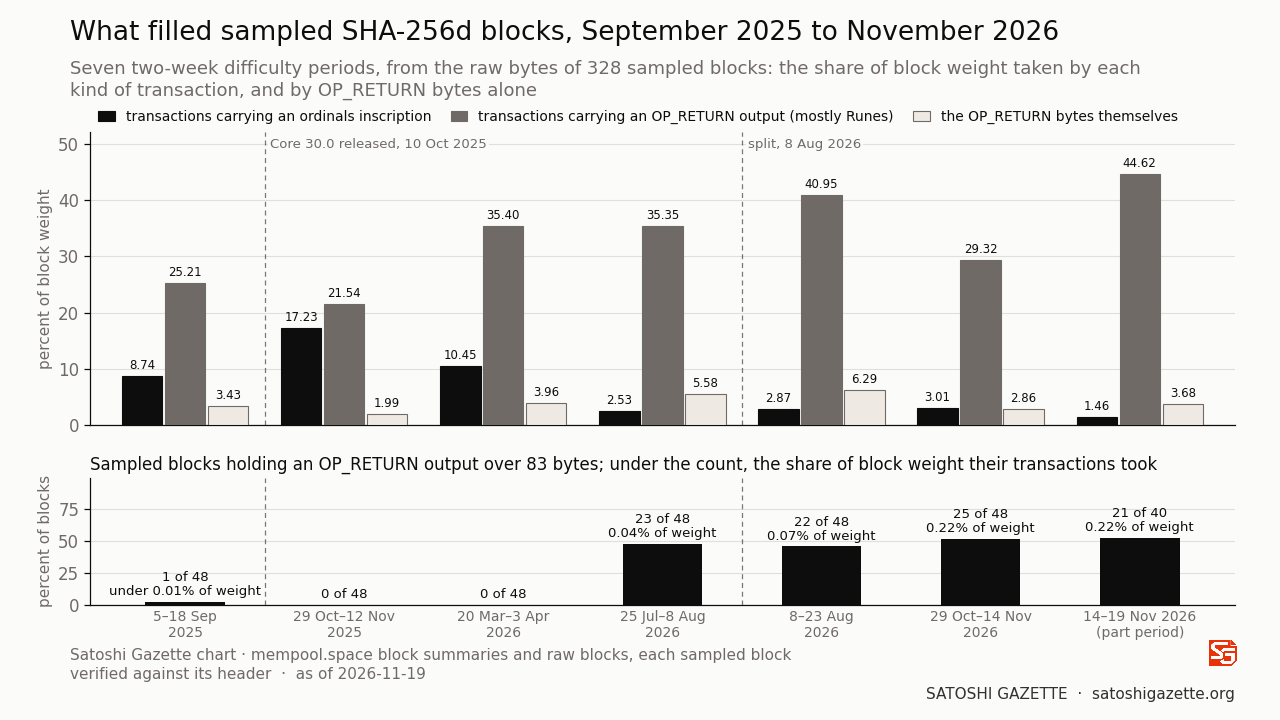
The question under the dispute is what blocks are for: keeping non-payment data out to hold down the cost of running a node and of paying, or leaving block space to whoever pays for it. The Gazette measured the SHA-256d chain in seven stretches from September 2025 to 19 November 2026, from every block's summary on mempool.space and 328 sampled blocks. Blocks within 10,000 weight units of the 4,000,000 limit made up 80.95 percent of a two-week difficulty period in September 2025 and 95.68 percent from 29 October to 14 November. The median block paid 1.98 million satoshis in fees in September 2025 and 1.81 million in the latest full period, under 1 percent of the block reward throughout, and the typical block's median fee rate was 1 satoshi per virtual byte in every stretch.19
Transactions carrying an ordinals inscription, data placed in a transaction's witness, took 17.23 percent of sampled block weight from 29 October to 12 November 2025 and 3.01 percent a year later. Transactions carrying an OP_RETURN output, most marked as Runes, a token protocol, take 21 to 45 percent of block weight, the OP_RETURN bytes themselves 2 to 6 percent; which figure is "data" is part of the argument. OP_RETURN outputs over 83 bytes, in 1 of 48 sampled blocks in September 2025 and none in late 2025 and March 2026, have been in about half since the period before the split; from 29 October to 14 November their transactions took 0.22 percent of block weight. Transactions BIP 110 would have made invalid took at most 17.50 percent of sampled weight in late 2025 and 3.47 percent from 29 October to 14 November, almost all inscription-style scripts.19
Method
Seven stretches of the SHA-256d chain: the difficulty periods beginning at blocks 913,248 (5-18 Sep 2025), 921,312 (29 Oct-12 Nov 2025), 941,472 (20 Mar-3 Apr 2026), 959,616 (25 Jul-8 Aug 2026), 961,632 (8-23 Aug 2026) and 973,728 (29 Oct-14 Nov 2026), and blocks 975,744 to 976,567 (14-19 Nov 2026, to the tip read at 10:38 UTC on 19 November). From each, the raw bytes of every 42nd block (every 21st in the last), 328 blocks in all, were read from mempool.space, and each block's header hash, transaction merkle root and witness commitment were recomputed from those bytes before it was counted. An inscription transaction has a witness item holding the ordinals envelope (hex 0063036f7264); an OP_RETURN output is one whose script begins with 0x6a, coinbase outputs excluded. Weight shares are the matching transactions' weight over the sampled blocks' total weight; OP_RETURN bytes are the output scripts' bytes at four weight units each over the same total. One transaction can fall in both classes, so the bars are not summed. Over 83 bytes means an OP_RETURN output script longer than 83 bytes, the default relay limit before Core 30.0. The bottom panel's bars are the share of sampled blocks; the labels give the counts. No modelling.
On the BLAKE2b chain, the last 1,008 blocks weighed 519,544 weight units at the median; 110 reached 780,000. The median block held 173 transactions and paid about 224,000 satoshis in fees.07 Renaud Cuny, who reads that chain from his own node, wrote on 27 October that one-of-fifteen multisig scripts carrying data jumped to about 60 percent of block space on 8 and 9 October and stayed at about 40 to 60 percent: "a consensus-level data limit moves data-carrying to whatever form is still allowed".20 Knots 29.4.3, of 28 October, by default counts multisig keys beyond ten that no signature uses as data, what Cuny calls "a policy rule targeting fake-multisig". On 7 November he wrote that the pattern "has nearly vanished" and that "The decline began Oct 25, before the release".8889
On cost, Lopp wrote: "From the node resource requirement perspective, non-monetary data is actually cheaper to verify because the node just skips over it."90 Kratter wrote: "It's not just storage, but also RAM and internet bandwidth", and "Big blocks and a big blockchain also disadvantage smaller miners in remote areas with poor bandwidth."9192 The Gazette did not measure what a node costs to run on either chain.
Decentralization, measured
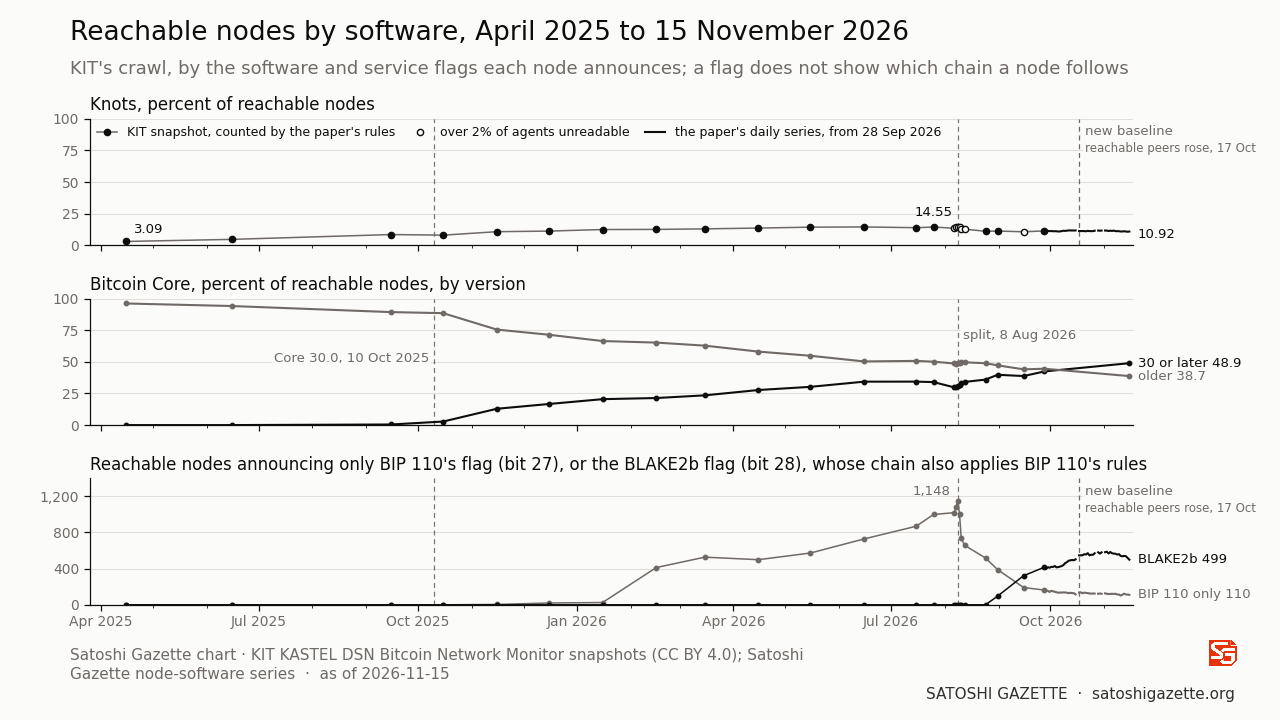
Nodes. On 15 November, 7,761 of the 8,859 reachable nodes in KIT's crawl, 87.6 percent, said they run Core and 967, 10.9 percent, Knots. Of the Core nodes, 4,332 run version 30 or later and 3,429 older versions.2170 Luke Dashjr's own dataset counts 5,385 listening nodes, 755 or 14.0 percent Knots, and adds an estimate of unreachable nodes whose method it does not state.22
Method
Reachable nodes are the IPv4 and IPv6 peers KIT's monitor was connected to when a snapshot was taken (no Tor or I2P), classified by the user agent each announces under the Gazette's published rules: a Satoshi agent with a later Knots token is Knots, a Satoshi agent alone is Core. 25 KIT snapshots, one a month from April 2025 and near-daily around the split, were counted by the Gazette from KIT's raw files with those rules; they are not part of the published series. The 24 snapshots up to 27 September 2026 draw the Knots and flag panels until the Gazette's published daily series begins on 28 September; that series leaves the days it held empty (16, 27 and 31 October) and records a new baseline from 17 October, when reachable peers rose from 8,704 on 15 October to 9,682. The Core panel uses the 25 snapshots only: Core is split by the major version in its agent, development (x.99) builds counted by their major, version 30 being the first line whose default OP_RETURN relay limit is 100,000 bytes rather than 83; the daily series files development builds apart, so it cannot give the same split. Flags are service bits 27 (NODE_REDUCED_DATA) and 28 (NODE_BLAKE2B) as defined in Knots' source, as each node announces them. Hollow points mark snapshots where more than 2 percent of agents were unreadable, above the published series' rule: up to 7.2 percent on 6 August 2026 and 4.9 percent on 8 August. Other counts use other populations and methods: coin.dance showed 21,602 public nodes on 19 November, and Luke Dashjr's dataset 5,385 listening nodes, Knots 14.0 percent.
Counts are argued over. Kratter's video of 2 November, "Bitcoin Core Sybil Attack Confirmed", cites coin.dance and a post he shared: "5000 Core listening nodes have disappeared since BIP110", and listening nodes "dropped from 27,000 to 18,000".4093 coin.dance, which says it counts listening nodes once per address, showed 21,602 public nodes, 19,512 of them Core, on 19 November; its page does not show its count for 8 August.46 KIT counts the nodes its crawler reaches, a different population: there, Core nodes fell from 8,294 on 8 August to 7,761 on 15 November and Knots nodes from 1,512 to 967. On the other side, Core contributors documented on the BNOC forum a set of nodes that Gregory Sanders saw in October 2025 relaying zero-fee transaction packages, "precluding stock Knots 29.1", and that b10c later saw announcing Knots. In March Antoine Poinsot wrote that they "have now switched to “signal” for BIP 110", and Will Clark that "These (sybil) nodes make up 92% of the “good” BIP110 nodes my bitcoin seed/crawler knows about". Their operator shut them down on 1 April: "intended outcome has been reached, proved the point".23 Mechanic had written in February: "I'm sure some nodes have been spun up for appearances (equally sure that's true of Core nodes)."94
Pools. In the month to 20 November, Foundry USA, AntPool and F2Pool found 2,750 of 4,402 SHA-256d blocks, 62.5 percent, and the two largest 45.2 percent. On the BLAKE2b chain, Lazarus and AlphaPool found 2,197 of 4,592, 47.8 percent, and the four largest 67.5 percent. Labels are each explorer's.2425 DATUM is software with which a pool's miner builds its own block template. Cuny wrote that in the week of 7 September about two thirds of BLAKE2b blocks were built by pools, and that now "roughly 9 in 10 blocks come from DATUM gateways working through a pool", though "The coinbase can’t tell you whether the gateway belongs to the miner or is hosted by the pool."20 The Gazette found no published measure of template origin for the SHA-256d chain as a whole. For one of its pools, Artymko told the Gazette that in the 90 days to 20 November, 96 percent of the hashrate on OCEAN used DATUM: "That's a measure of hashrate; we don't have a verified block-by-block percentage to share for that period."
Maintainers. From 1 August to 18 November, five accounts merged Core's 534 merge commits, and 96 authors wrote its other 1,071 commits. Between Knots' 29.4 and 29.5 tags, luke-jr made 1,844 of 1,864 merge commits, and 15 accounts wrote the code added since 7 August. The figures are not directly comparable: 248 of the 250 commits GitHub's comparison page lists between those tags carry one date, 7 May, so Knots cannot be counted by calendar dates.2627 In the same months 32 authors opened 137 pull requests on Knots; 28 were merged and 56 remain open.95
What each side means. Knut Svanholm, who backed BIP 110: "If Bitcoin is going to stand any chance at surviving long-term, decentralized mining is crucial."96 OCEAN: "Bitcoin mining and block template construction have become concentrated in a small number of pools".29 The Core contributors' statement ties relay to mining: it helps miners learn of fee-paying transactions "so they do not need to rely on out-of-band transaction submission schemes that undermine mining decentralization", and "Reduced latency helps prevent large miners from gaining unfair advantages".03
The pools
None of AntPool's 412 blocks in the mandatory window set bit 4, nor did Foundry's 488 or F2Pool's 313. Foundry invited its clients to "cast your vote with Foundry USA Pool™".28 KuCoin's news service reported in April that Wang Chun, a co-founder of F2Pool, posted on X "clearly opposing the Bitcoin BIP-110 and BIP-54 protocol upgrades".47 OCEAN wrote on 30 August: "Our pool remains on SHA-256."29 Artymko told the Gazette that OCEAN "supported miners' ability to choose whether to signal for BIP-110 or follow the proposed soft fork", and that "The proposal did not gain consensus, and its rules are not part of the Bitcoin network OCEAN mines today." "When its supporters announced a hard fork to Blake2b, we declined to support it," he wrote. "We consider that a separate coin. OCEAN remains a Bitcoin-only mining pool and continues to mine on the Bitcoin network using SHA-256."
On 7 September the GitHub account BitcoinMechanic, which no record ties to Mechanic's X account, opened a Knots pull request saying "AlphaPool is enormous (>46% at present time)" and proposing to blacklist its address; its description opens with the warning "DO NOT RUN THIS CODE -Luke". A commenter wrote: "Blacklisting an operator’s address is an explicit censorship action."31 @TwhitNub101, whose X profile links AlphaPool, answered: "Never in all my years have I seen submitting hashrate and securing a blockchain protocol in and of itself perceived as a 'hostile attack.'" Mechanic wrote that "if we don't hold ourselves to a higher standard than that then the motivation for forking is largely eliminated".9798
The reward lock, called CBM for coinbase maturity on its pull request, divided the BLAKE2b side too. Luke Dashjr wrote that "we should let Long CBM expire after the 45 days", disclosing that "the existing long maturity has created de facto problems for CONVOY", the pool his X profile says he runs. Chris Guida, a credited contributor to Knots 29.4.3, wrote that "removing the option to void rewards from the table would be a fatal mistake"; Greg Tonoski, a BIP 110 supporter: "I am planning not to deploy this PR on my node." BitcoinMechanic, which opened this pull request too, wrote that "In theory I consider it backwards for the stated goal of decentralizing mining", but that results since the 45-day lock "further justifies experimenting with longer CBM".30 On 22 October Luke Dashjr wrote: "But it's not my decision, and the Bitcoin community seems to clearly support it, so I will accept it."51 @kwsantiago, whom Knots' X account credits with releasing 29.4.399, wrote: "As the community decided, mining rewards from that block until September 2027 take about 180 days to mature".100 Luke Dashjr: "The community has spoken. 180-day maturity, it is."101
What comes next
On the SHA-256d chain, Core 29.5, 30.4, 31.2 and 32.1, of 27 and 28 October, and 30.5 and 31.3, of 20 November, the releases since the split, change no data policy.10248115 The two of 20 November fix a flaw rated medium severity, by which a peer could stall a node with repeated announcements of an orphan transaction; 32.1 already carried the fix, and Core's advisory says: "The 29.x series has reached end of life and will not receive a fix."116 The live soft-fork proposal there is BIP 54, the consensus cleanup; Optech reported on 6 November that its 64-byte transaction rule "is still the most contested rule".49
On the BLAKE2b chain, open proposals on the reward lock range from keeping the 45-day lock until BIP 110's limits expire52 to a 280-day lock under which "RDTS becomes permanent"103; the third step of Luke Dashjr's September plan, to "withhold rewards for any blocks produced by non-miners (ie, Stratum-to-pool)", is still written down.62 On 10 November Luke Dashjr declared a new BIP repository "official". Its account of August, and Murch's answer, are set out above. Of the new repository he has said: "Currently, it's just me with access. Hoping others will volunteer as things mature."33104 On 18 November he opened a pull request to "handle each RDTS rule individually so we can retain some and not others."32
What is not on the record
The Gazette found no public record of the result of Foundry's client vote; any AntPool statement; any record beyond OCEAN's account of who mined blocks 961632 to 961639, which mempool.guide labels OCEAN; which testnet4 block hash selected BLAKE2b-256 after the retry; who runs Lazarus, the BLAKE2b chain's largest pool; or any exchange or custodian statement on the BLAKE2b chain. Since 8 August no proposal on the bitcoindev list seeks a new data limit for the SHA-256d chain.105
The Gazette asked AntPool, Foundry, F2Pool, OCEAN, Luke Dashjr, Dathon Ohm and the BIP editors for answers on 19 November between 15:29 and 15:32 UTC, with replies asked by 16:00 UTC on 20 November, and wrote to Luke Dashjr again on 20 November at 09:47 UTC with the same deadline. Murch, a BIP editor, answered on 19 November at 19:37 UTC, and Mark Artymko, OCEAN's president, on 20 November at 15:39 UTC; their answers are quoted above. AntPool's support address sent an automatic reply saying it could not give an official statement. Foundry, F2Pool, Luke Dashjr, Dathon Ohm and the other four BIP editors had not answered by publication.