Bitcoin Owes No Interest. Its Largest Holder Owes $1.76 Billion a Year. The Price of Money Just Rose.
The Federal Reserve raised rates on Wednesday for the first time since July 2023, twelve to nothing, undoing its December cut; the Bank of Japan followed a day and a half later, and both named the Middle East. A coin held in your own keys has no coupon and no creditor. Strategy’s own filing puts its expected preferred dividends and interest at $1.76 billion a year — about $2,083 for each of its 845,050 coins — paid by selling stock, at a rate its board reviews monthly against “market yields.” That is the bill a rate rise arrives at.
On Wednesday afternoon the Federal Open Market Committee raised the federal funds rate by a quarter point, to a range of 3¾ to 4 percent, by a vote of twelve to nothing.01 It was the first increase since July 26, 2023.12 Every one of the twenty-four meetings in between had either held or cut.
The statement is five sentences long. Two of them do the work: "Inflation remains elevated," and "uncertainty remains elevated owing, in part, to geopolitical developments." The rest is the vote.
About a day and a half later the Bank of Japan's Policy Board raised its overnight call rate to around 1.25 percent from around 1.0, seven votes to two, effective September 24.05 Its summary named the same risk in almost the same words — "the situation in the Middle East" — and said the Bank "will continue to raise the policy interest rate."13
That is the news. The price of borrowed money went up on both sides of the Pacific inside thirty-six hours, and both central banks pointed at the same map.
What a hike is, and what it is not
The Fed's move undoes one thing exactly. On December 10, 2025 the Committee lowered the range to 3½–3¾.04 It held there through January, March, April, June and July. In July three members — Hammack, Kashkari and Logan — voted against holding, "who preferred to raise the target range for the federal funds rate by 1/4 percentage point at this meeting."03 In September the other nine came round. The projection table the Committee published alongside the decision puts the median member's expectation for the end of this year at 4.1 percent, up from 3.8 in June, and 4.1 for 2027, up from 3.6.02 Against a range that now tops out at 4.0, a 4.1 median is a polite way of saying one more.
It is worth being plain about what an interest rate is a price of. It is the price of borrowing dollars for a period and giving them back. A change in that price reaches everything that is built on borrowed dollars and does not reach anything that is not.
A bitcoin held in keys you control is not built on borrowed dollars. It carries no coupon, owes no dividend, has no creditor and no maturity. Nothing the FOMC decided on Wednesday changes what it costs to keep one for a year, because that cost is zero. The interesting question is not what the hike does to bitcoin. It is what the hike does to the structures that stand between a holder and a bitcoin, because those structures do borrow — and the largest of them writes down, in its own filings, exactly what that borrowing costs.
The bill, in the company's own words
Strategy Inc held 845,050 bitcoin on September 13.08 It acquired them, its quarterly report says, by "issuing class A common stock and preferred securities through ATMs to fund bitcoin purchases."06 The preferred securities are the part that matters here. At June 30 there were five series outstanding with a combined face value of roughly fifteen and a half billion dollars, paying 8, 10, 10, 10 and — for the largest, STRC, $10.5 billion of it — a variable rate that the company set at 11.50 percent for June and describes as currently 12.00 percent.
The 10-Q states the running cost of that stack in one sentence: "our current expected annual preferred stock dividend payments and interest expense were approximately $1.76 billion, in aggregate." The debt itself is nearly free — five series of convertible notes, $6.7 billion in total, at coupons between zero and 0.875 percent. The cost is not in the bonds. It is in the preferred.
The cash flow statement shows the bill being paid. Dividends paid on preferred stock in the first six months of 2026: $629.2 million. In the same six months of 2025: $58.1 million. The quarter to June alone carried $507.7 million of declared preferred dividends against $49.0 million a year earlier — a tenfold increase in the fixed obligation, in twelve months.
Where does the money come from? The company's 8-K for the week of August 24 to 30 sets it out with unusual clarity. It sold 4,531,421 shares of common stock for $602.8 million net. Of that, "$50.7 million in net proceeds from MSTR Stock sales were used to fund dividends on Strategy's STRC Stock, $369.7 million … to fund bitcoin purchases, $151.8 million … to fund repurchases of STRC Stock," and $30.0 million went to cash.07 Common stock is sold to pay the dividend on preferred stock. That is not a criticism; it is the design, and the company discloses it every Monday.
Then, for two weeks, nothing. September 1 to 7: no shares sold, no bitcoin bought. September 8 to 13: no shares sold, no bitcoin bought, and $139.3 million of the company's cash spent buying back 1,420,467 shares of the variable-rate preferred.08 The bitcoin count has not moved since August 30.
Where the hike enters
None of this makes a rate rise a mechanical event for Strategy. The convertible coupons are fixed and tiny; four of the five preferred series are fixed; the company holds a $5.10 billion "USD Reserve" that its board policy reserves "only to support the payment of preferred stock dividends and interest expense," with a required floor of twelve months' worth. At $1.76 billion a year, $5.10 billion is a little under three years. The reserve is not the story.
The story is STRC, and the company's own rule for it. Under the policy adopted in June, management will "evaluate the STRC dividend rate monthly based on a range of factors, including STRC trading levels, market yields, credit spreads, the price and volatility of bitcoin, USD Reserve coverage, capital market conditions, and our overall capital structure," with the stated aim of keeping the shares trading "near its targeted range of $99–$100."06
Read that list again. "Market yields." A security that must pay whatever it takes to hold par against the yields available elsewhere has its rate set, at one remove, by the FOMC. When Treasuries and money funds pay more, a 12 percent perpetual preferred is worth a little less at par than it was on Tuesday, and the monthly review has one lever that restores it. The company says it "will not necessarily increase the STRC dividend rate solely because STRC trades below its $100 per share stated amount." It also spent $291 million in three weeks buying the security back, which is the other lever.
Wednesday did not change Strategy's bill. It changed the price of the thing the bill competes with.
The ladder
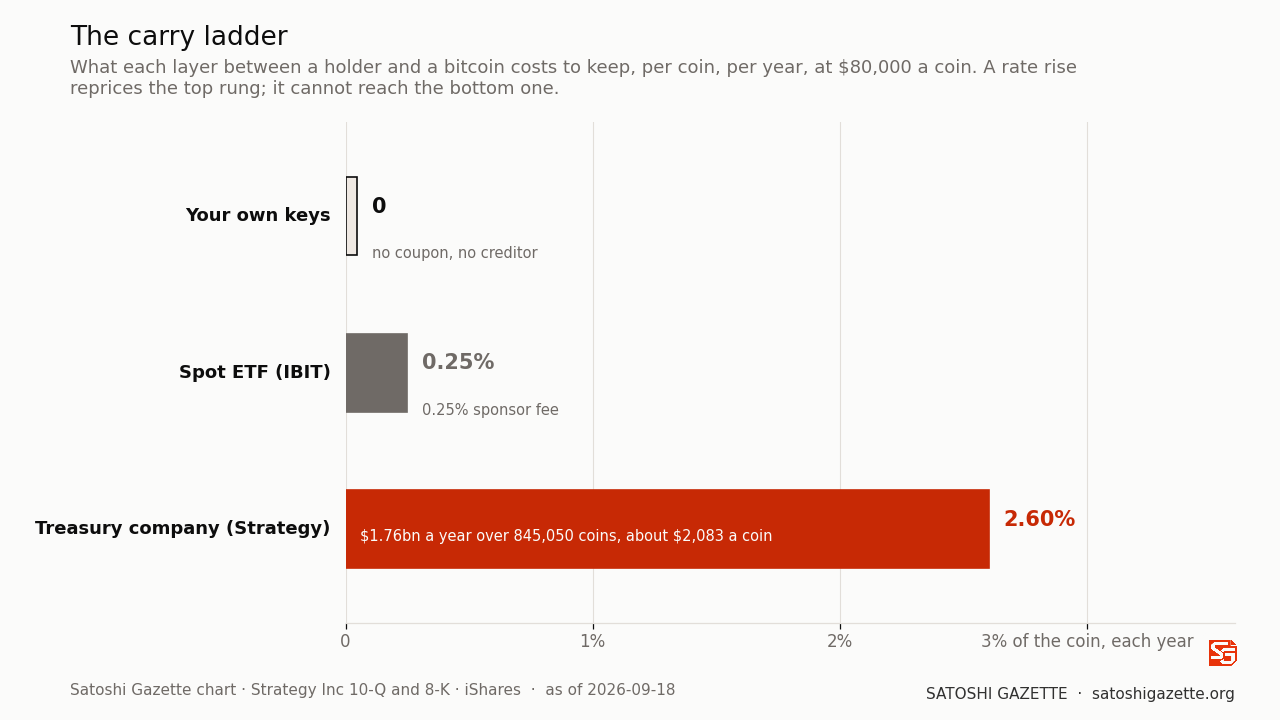
Put the three ways of holding a bitcoin on one scale, per coin, per year.
Method
Treasury-company rung: $1.76 billion, the 'current expected annual preferred stock dividend payments and interest expense' stated in Strategy's Q2 2026 10-Q, divided by 845,050 BTC held as of September 13, 2026 per its 8-K, giving about $2,083 per coin; expressed as a share of an $80,000 coin, 2.60 percent. ETF rung: the 0.25 percent sponsor fee stated on the iShares product page. Keys rung: zero by construction. No modelling; the dollar price is a unit, and a different price moves the treasury rung proportionally.
Your own keys: zero. A share in the iShares Bitcoin Trust: a sponsor fee of 0.25 percent, stated in the prospectus and on the product page.10 A share in Strategy: $1.76 billion divided by 845,050 coins is about $2,083 per coin per year — at $80,000 a coin, 2.6 percent, before any question of the price at which the company bought.
The arithmetic is not a verdict on the company; it is the cost of a structure, disclosed by the structure. A holder who wants leverage, a listed wrapper, or a dollar dividend stream backed by bitcoin is paying for those things at the rate shown. What a rate rise does is make the top rung of the ladder cost more to maintain and the middle rung slightly less attractive relative to cash, while the bottom rung is where it was, because there is nothing there to reprice.
Two things the rest of the ledger says
First, the miners, who also borrow to build. Bitcoin's difficulty made its all-time high at height 921,312, on the adjustment of October 29, 2025. It is 18.3 percent below that today and has gone 323 days without a new one; the last eight adjustments were each within about a percent of flat.09 A machine bought on borrowed money has to clear the cost of that money before it clears anything else, and that cost rose on Wednesday. The paper will take the mining question on its own in a separate piece; here it is enough to say the chain shows an industry that stopped growing eleven months ago, and the price of its capital just went up.
Second, the buying. This paper's treasury ledger, which admits only holdings a filing discloses, records 6,403 bitcoin added by its eleven verified companies in periods ending since June — Strategy's 4,603 and Strive's 1,800.11 Glassnode, reported by CoinDesk on Thursday, puts public-company purchases at about 5,900 over three months and the group's average entry at $80,500.14 The two readings differ in method and agree in shape: the corporate bid that was a hundred thousand coins a quarter a year ago is a few thousand now. A structure that buys bitcoin with sold stock buys less when the stock is worth less and the dividend it must fund is worth more.
What the paper concludes
A central bank cannot reach a bitcoin. It can reach a balance sheet, and every balance sheet that holds bitcoin on your behalf is a dollar business with a dollar bill. This week the bill got a little larger for the largest of them, by the mechanism its own filing describes, and the chain recorded no change at all for anyone holding the coin itself.
The 9.12 percent of issued bitcoin that this paper can prove is held by somebody else on somebody's behalf sits on those balance sheets.satoshigazette.org The remainder, as the custody desk says every time it prints the figure, is unclassified — which is not proof of self-custody. But it is the only part of the supply to which Wednesday's decision, and Thursday's, did not apply.