Bitcoin Mining May Have Peaked. The Chain Agrees More Than His Own Numbers Do.
Saifedean Ammous argues mining has stopped growing for good. This desk checked his four load-bearing figures against the sources he names. The difficulty stretch is longer than he says — 324 days now, against his 305. The epoch subsidy multiple is 21 percent, not 28. But the peak he nominates as the empirical test is not where Cambridge’s own series puts it: the high was 227 TWh in October 2025, not 190 in December, and December was already the decline.
Saifedean Ammous published an argument on Monday that bitcoin mining has stopped growing and may never grow again.01 It has been read a hundred and fifty-eight thousand times. It is the most interesting thing written about mining this year, and it is built on four checkable numbers.
This desk checked them against the sources he names. Two of them are wrong in his favour. One does not survive contact with the source. The thesis stands up better than its own arithmetic.
The argument
The mechanism is a hurdle rate. Every four years the subsidy halves, so the dollar value of what miners are paid for a day's work falls by half unless the price doubles. A doubling over four years is 18.92 percent a year. Below that, he argues, the rational miner stops adding machines, and since AI now bids for the same power and the same buildings, the hurdle is higher still.
It is a model, not a measurement, and he says so — "This piece presents the argument as a testable hypothesis, provides the data that would test it." A reader should hold it the way he offers it. What follows is not a referendum on whether he is right. It is a check of the four figures he rests on.
One: the difficulty stretch. True, and understated.
He writes that difficulty "hit its all-time high on October 30, 2025, and 305 days later, it has yet to recover or exceed that level."
The chain says the high was set by the adjustment at height 921,312, timestamped 10:14 UTC on 29 October 2025, at 1.5597 × 10¹⁴.02 It has not been beaten since. Difficulty today is 18.29 percent below it.
But 305 days after 30 October 2025 is 31 August 2026. On the day he published, 15 September, the stretch was 320 days. Today it is 324. His own number was a fortnight stale, and it made his case weaker than the record does.
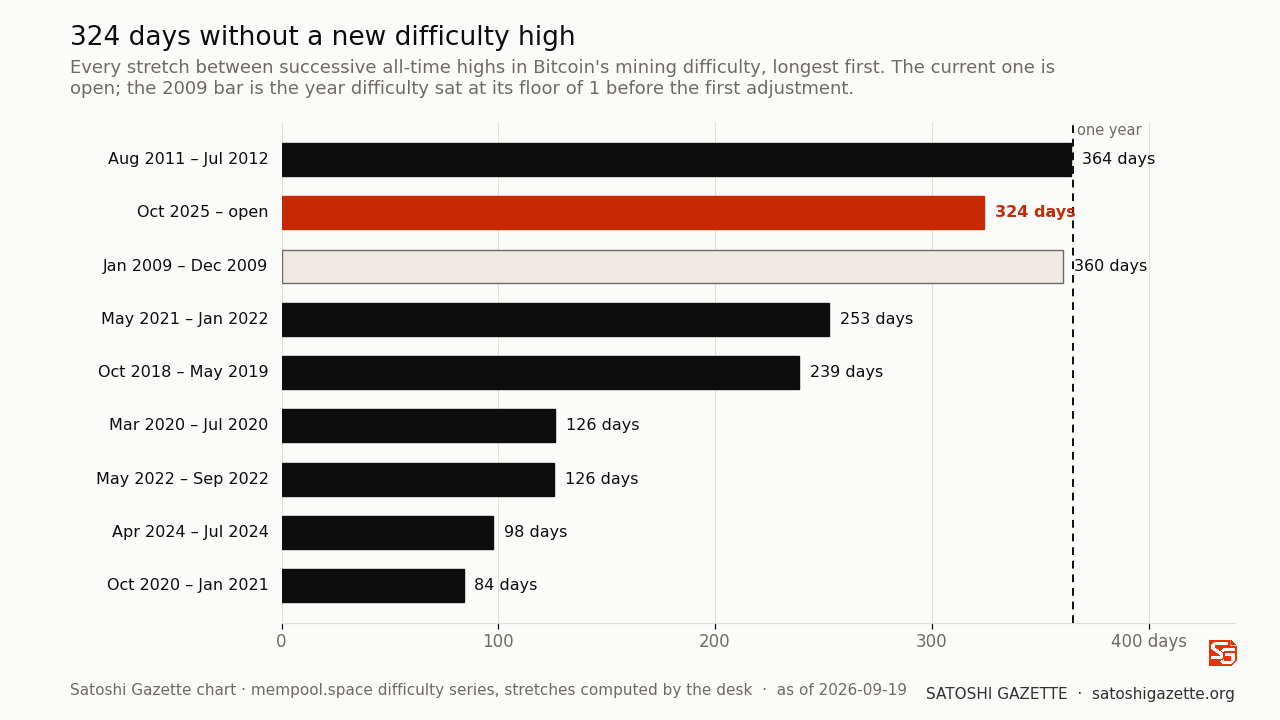
He also calls it "the second-longest period of bitcoin difficulty failing to make a new all-time high." Recomputing every stretch between successive highs from genesis:
Method
The difficulty series from mempool.space's hashrate/all endpoint (465 adjustments from genesis) was scanned in order; each time a value exceeded every prior value, the interval since the previous such value was recorded as a closed stretch. The open stretch is measured from the October 29, 2025 adjustment to 00:00 UTC on September 19, 2026. The 2009 bar is the period from genesis to the first adjustment, during which difficulty was the constant 1; it is shown outlined because it was a floor, not a decline. No modelling.
The 2011–12 record is 364 days, not 363; the 2021–22 episode is 253, not 252; both within a day of his figures, which is what you would expect from different timestamp conventions. The ranking holds — with one qualification he does not make. There is a 360-day stretch in 2009, from genesis to the first adjustment, when difficulty sat at its floor of 1 because there was not yet enough hashrate to move it. Excluding it is defensible; it was a starting condition, not a decline. But it is an exclusion, and the chart above shows it rather than hiding it.
The stretch passes the 2011–12 record on 28 October 2026 and completes a full year on 29 October. That is a falsifiable date, six weeks out, and this paper will print what happens on it.
Two: the epoch subsidy multiple. Also understated.
He writes that "the fifth epoch, so far, has seen the mining subsidy increase by only 28% over the previous epoch" — the figure that carries the whole argument, because if subsidy revenue barely grows across a halving, the hurdle is not being cleared.
Taking mempool's historical price series and averaging across each halving epoch: epoch four, from May 2020 to April 2024 at a 6.25 subsidy, means $34,593. Epoch five, from April 2024 to today at 3.125, means $83,933.04 That is a price multiple of 2.43, and because the subsidy halved, a subsidy-revenue multiple of 1.21 — twenty-one percent, not twenty-eight.
The gap is method, not error: a different price source, a different window, or trading days rather than calendar days will each move it. But it moves against him. At 21 percent, four fifths of a four-year cycle in, his hurdle is missed by more than he claims.
His third figure survives. The most valuable day of mining in the previous epoch was 14 March 2024: 144 blocks at 6.25 BTC, at a price that peaked at $73,599 that day, is about $66 million of subsidy. For this epoch to match it the price must reach roughly $143,000 to $147,000 depending on which print of that day you take; he says $147,600. This epoch's high was $126,080, on 6 October 2025. He says $126,000. Correct.
Three: the Cambridge claim. This one fails.
Here the piece asserts something its source does not support. He writes: "Preliminary data presented by the Cambridge Centre for Alternative Finance put annualized Bitcoin mining electricity demand at approximately 190 TWh in December 2025" and offers December as the candidate peak — "December 2025, at roughly 190 TWh annualized, may prove to have been Bitcoin's peak electricity-consumption rate."
Cambridge's own published daily series says otherwise.03 The highest best-guess annualised estimate in the entire series is 227.43 TWh, on 18 October 2025 — two months before the date he names and twenty percent above the figure he gives it. December 2025 ranged from 189.56 to 211.75 TWh. December was not the peak. December was already the decline.
This matters because he proposes the December figure as the empirical test: the hypothesis is falsified, he says, if the series "rises sustainably above that level." Testing against 190 sets the bar at a number the index had already fallen to. Tested against Cambridge's actual high of 227, the claim that consumption has peaked is a stronger statement and a harder one to make.
Two honest caveats, both against the paper's own convenience. Cambridge's published daily series ends on 17 March 2026, at 148.18 TWh; it does not cover the mid-2026 period he characterises as "the high-130 TWh range," so this desk can neither confirm nor refute that phrase from the published data. And the live figure on Cambridge's front page today reads 157.54 TWh — above the high-130s, below December, well below October. The direction of his argument is intact. The peak he names is not where he puts it.
What the paper concludes
Three of the four numbers point the same way he does, and two of them point harder. One misidentifies the peak of the very index he nominates as the test. That is a real flaw in a real argument, and naming it is not a rebuttal of the thesis; it is what a paper is for.
On the thesis itself this desk takes no position, because a hurdle rate is a claim about what miners expect, and expectations are not on the chain. What is on the chain is this: 324 days without a new high, 18.29 percent below the October 2025 record, the longest such stretch in fourteen years and six weeks from the longest ever. Set that beside what this paper reported yesterday — that the cost of borrowed dollars rose on both sides of the Pacific in thirty-six hourssatoshigazette.org — and the capital case for adding machines is harder this month than last.
One more thing the chain says, which the thesis does not address. While the industry stopped growing, it also concentrated: three pool labels built 60.04 percent of last week's blocks, the highest reading this desk has recorded.satoshigazette.org An industry that stops attracting capital does not become smaller evenly. It becomes smaller around whoever already has the cheapest power — and the coordination question gets sharper, not softer, on the way down.
Update, 21 September 2026. Difficulty retargeted upward by 4.16 percent on 19 September, at height 967,680 — six and a half hours after this Story published, and the largest increase since 27 June. The stretch without a new all-time high now stands at 327 days, and difficulty is 14.88 percent below the October 2025 record rather than the 18.29 percent reported above. Hashrate came back. The 2011–12 record of 364 days still falls on 28 October, and this paper will report what happens on it.