Three Pool Labels Built 57.6% of Last Week’s Bitcoin Blocks
The share stayed near 59% across one- and three-month windows—but pool attribution shows a coordination surface, not miner ownership.
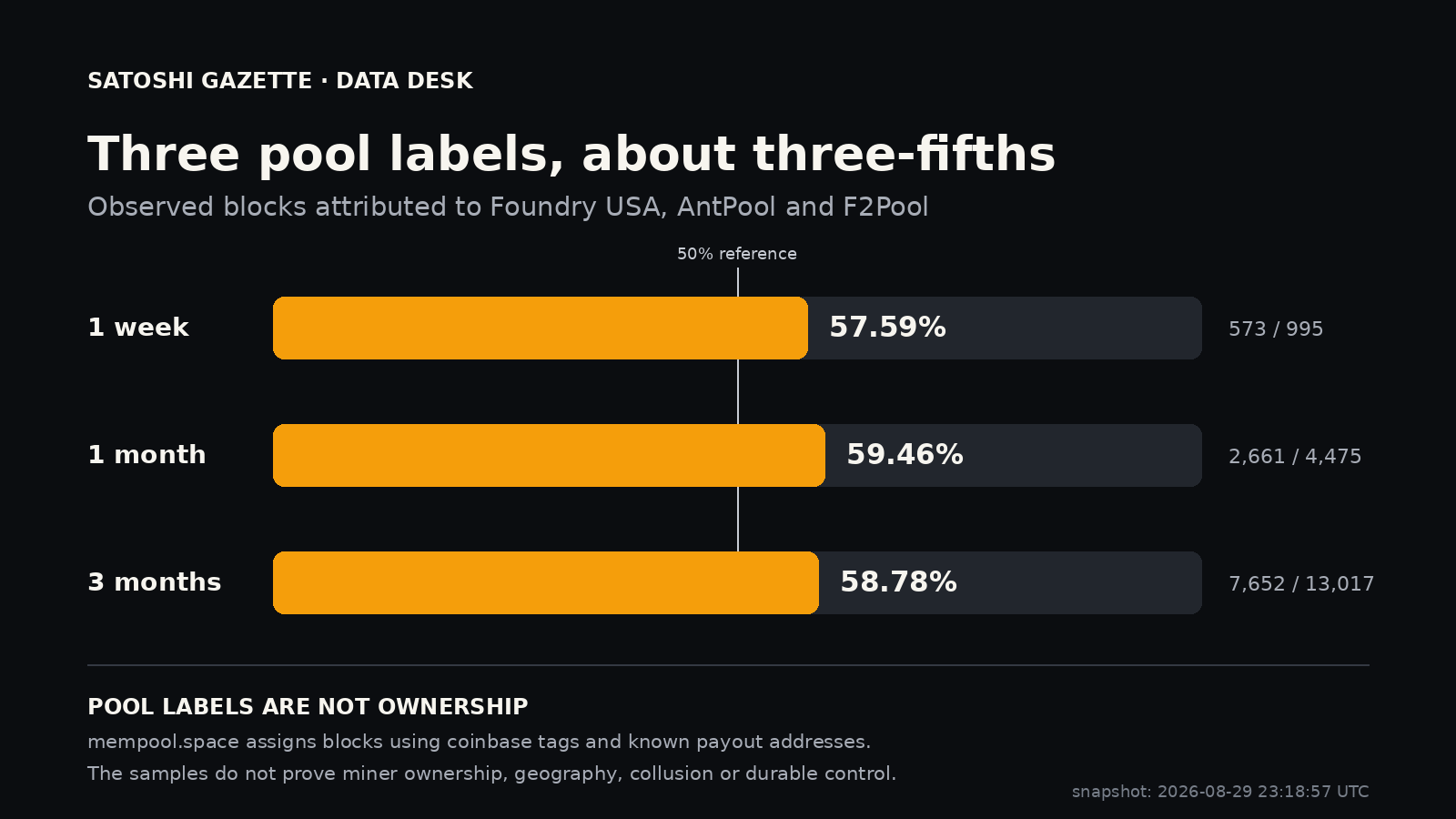
At 23:18:57 UTC on August 29, mempool.space attributed 573 of the previous week’s 995 Bitcoin blocks to three pool labels: Foundry USA, AntPool and F2Pool. That is 57.59% of the observed sample.
It was not only a noisy day or week. The same three labels accounted for 2,661 of 4,475 blocks over one month, or 59.46%, and 7,652 of 13,017 over three months, or 58.78%. Across all three windows, roughly three out of every five observed blocks carried one of the same three pool identities.
Method
Retrieved the 1w, 1m and 3m public pool endpoints at 2026-08-29T23:18:57Z, summed the integer blockCount values for Foundry USA, AntPool and F2Pool, divided each sum by the endpoint’s total observed blocks, rounded to two decimals, and checked the pool-attribution limitations against mempool’s public mining-pools methodology repository.
The tempting headline would be that three companies control almost 60% of Bitcoin mining. The data does not establish that. Mempool’s public methodology assigns pool labels by matching coinbase tags or known block-reward payout addresses. A label does not reveal who owns every connected machine, where those machines are, whether operators coordinate, or how quickly miners could redirect their work.
There is another counterfact worth keeping in view. The top two labels remained below half of observed blocks in every window: 42.21% over one week, 43.37% over one month and 44.16% over three months. The combined share crosses 50% only when F2Pool is added. That is not a reason for comfort or panic; it is the boundary the evidence actually shows.
What the repeated result does reveal is a visible coordination surface. Bitcoin’s miners may be widely owned, but recent blocks arrive under a much smaller set of pool identities. For ordinary users, the useful questions are practical: can miners detect unwanted policy, switch without permission, and keep enough independent alternatives alive that one pool’s rules do not become the network’s rules?
Satoshi Gazette will keep this as a longitudinal measure, preserving raw block counts, retrieval times and attribution-method changes. A future shift may reflect miners moving, pools changing labels, or the underlying identification file being revised. Those possibilities belong in the record too.
Bitcoin decentralization should not be awarded by slogan or condemned by logo count. This snapshot does not prove capture. It gives us a reproducible number—and a clearer place to look for it.