The Senate Did Not Vote on the Clarity Act. It Voted on Whether to Start.
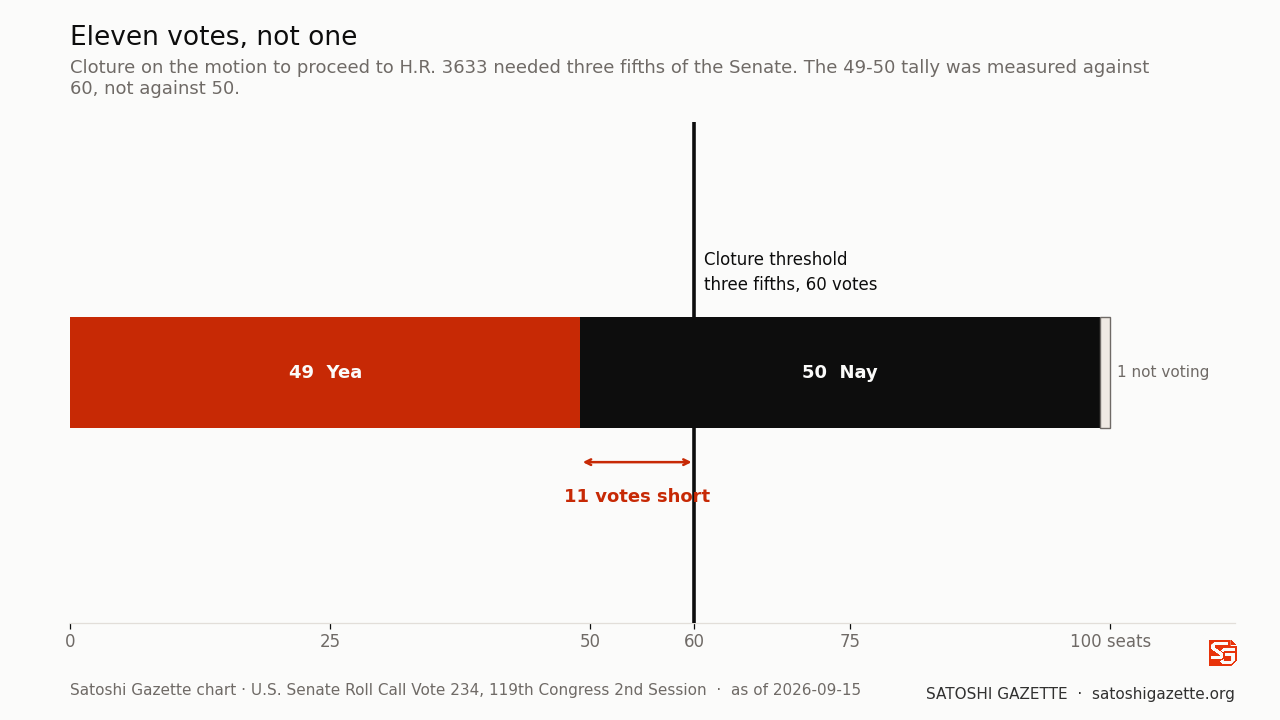
Cloture failed 49 to 50 — eleven votes short of the sixty required, not one. The final text everyone argued about was never before the Senate; by its sponsors' own terms it would only have been offered if that vote had carried. What goes unsettled is a question worth naming plainly: who is allowed to earn on money they hold.

On Tuesday afternoon the United States Senate spent a few minutes on the Digital Asset Market Clarity Act, and then moved on to a bill about student athletes.
The headlines that followed said the Senate blocked the bill, rejected it, killed it. The record says something narrower, and more interesting. At 2:19 PM on September 15 the Senate voted on cloture on the motion to proceed to H.R. 3633 — a vote about whether to begin debating the bill at all. It failed, 49 to 50, with one senator not voting.01
Cloture needs three fifths. Sixty votes. Coverage that framed Tuesday as a near miss — one vote short, a single defection from success — was reading a majority threshold onto a supermajority question. The motion was eleven votes short, and it was never within eleven votes.
Method
Seat counts read directly from the Senate's grouped-by-vote-position listing for Roll Call 234: 49 Yea, 50 Nay, 1 not voting. The 60-seat rule is the three-fifths requirement stated on the same page. The 11-vote figure is 60 minus 49. No modelling or third-party tally.
What the roll call says, and the statements do not
All 49 votes to proceed were cast by Republicans. No Democrat voted yes. Senator Coons of Delaware did not vote.
Four Republicans voted no: Susan Collins of Maine, Josh Hawley of Missouri, Jerry Moran of Kansas and Thom Tillis of North Carolina. The two independents, King and Sanders, voted no as well.
The senator who has carried this bill since 2022 called the result "a party-line vote, with every Senate Democrat voting no."03 Every Senate Democrat who voted did vote no. It was still not a party-line vote, because four members of her own party voted with them.
One of those four is worth naming twice. The sponsors' release the previous day said the final text "includes new ethics language which reflects substantially all of the Tillis-Gallego ethics proposal."02 Tillis then voted against proceeding to it.
The text nobody voted on
This is the part the week's coverage mostly skipped, and it sits in the sponsors' own release, one line from the end of the substance:
If cloture is invoked on the motion to proceed on Tuesday afternoon, this legislative text would be offered as an Amendment in the Nature of a Substitute.
Read it again with Tuesday's result in hand. The final draft — the 126 changes made at Democrats' request, the ethics language, the Treasury circuit-breaker, the developer protections — was conditional. It would be offered if cloture carried. Cloture did not carry. The document that consumed three days of argument was never introduced, never debated, never amended and never voted on.
The Senate declined to open a door. Everything the reporting described was behind it.
The question it would have settled
Strip the draft down and one fight ran through the whole summer: whether a company holding your dollars may pay you for leaving them there.
Section 404 said no. Its prohibition, as quoted by the Consumer Federation of America's Corey Frayer in May, barred a covered party from paying "any form of interest yield solely in connection with holding" payment stablecoins in a manner "economically or functionally equivalent" to interest on a bank deposit.
Then it carved out activity-based and transaction-based rewards. Frayer read the carve-out and pointed out that permitted rewards "may be calculated by reference to balance, duration, tenure, or any combination of the foregoing."04 A payment is forbidden when it is calculated on your balance over time, and permitted when it is calculated on your balance over time. His conclusion was that the ban was not meaningfully there.
That was the spring text. By September the sponsors had stopped trying to settle the argument and installed a switch instead. The final draft gave the Secretary of the Treasury new authority to act if payment stablecoins pulled deposits out of community banks — a "strong circuit-breaker to protect community banks and the farmers and small businesses who rely on them," in the release's words.
Notice what a circuit-breaker does and does not do. It does not answer whether you may be paid on a balance you hold. It appoints an official to decide later, and only if the banks are losing enough deposits to make it worth deciding.
Why this belongs in a Bitcoin paper
Three reasons, and two of them are in the Senate's own description of the bill. The clerk's measure title records H.R. 3633 as a bill to regulate digital commodities through the SEC and CFTC, "to amend the Federal Reserve Act to prohibit the Federal reserve banks from offering certain products or services directly to an individual, to prohibit the use of central bank digital currency for monetary policy, and for other purposes."
A statutory bar on the Fed banking individuals directly, and on a central bank digital currency being used as a monetary policy instrument, is not a stablecoin footnote. It is the shape of the account layer ordinary people would have been offered.
The third reason is narrower and closer to home. The final draft carried edits to the Blockchain Regulatory Certainty Act "to shield developers from money transmission registration requirements and establish a strong civil safe harbor." People who write wallet and node software have been asking for that protection for years. It was in the text that was never offered.
What is unchanged
For anyone holding bitcoin in their own custody, Tuesday changed nothing. That is most of the point. No cloture vote was required for you to hold a key, and no Treasury switch governs whether your own coins are yours.
The people waiting on this vote were the ones holding a claim rather than an asset: a balance on an exchange, dollars in a payment app, a reward that arrives monthly and can be reclassified by rulemaking. They are where they were on Monday — paid at a company's discretion, under terms the company writes, with the federal answer deferred to a Congress that has now spent 2026.
In July, releasing the merged text, the bill's subcommittee chair called the coming weeks "likely the last real chance we will have for years to get this right." She was describing a deadline she expected to meet.
This piece reports what the Senate roll call and the sponsors' own releases say. It does not assess whether the Clarity Act would have been good law, predict whether it returns, or describe the market's reaction to the vote.