Bitcoin Mining Difficulty Goes a Year Without a New High. No Stretch in the Chain's History Has Run Longer.
The all-time high was set at block 921,312 on 29 October 2025. At 13:29 UTC on 28 October the stretch since passed the 364-day record of 2011–12, and at 10:14 UTC today it reached a full year. The record it beat went twice as deep. What ends this one is a single retarget above 155,973,032,196,071.95.
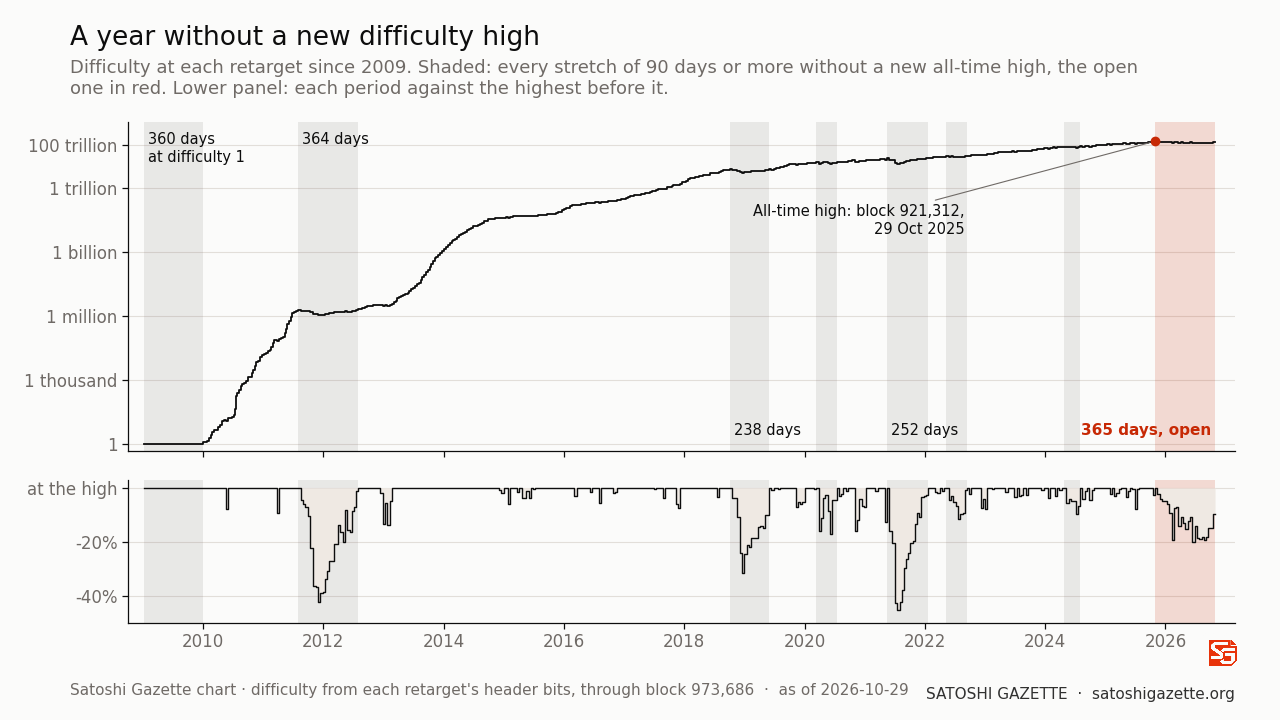
Bitcoin's mining difficulty has gone a full year without a new all-time high. The high was set at the retarget at block 921,312, stamped 10:14:53 UTC on 29 October 2025, at 155,973,032,196,071.95.01 Twenty-five retargets have followed. Eleven raised difficulty and fourteen lowered it, and none reached the high.
The stretch passed the longest in the chain's history at 13:29:51 UTC on 28 October. That record ran 364.14 days, from the retarget at block 139,104 on 1 August 2011 to the one at block 191,520 on 30 July 2012, which set a new high of 2,036,671.09.05 The first block stamped past the record was 973,559, at 13:38:39 UTC.02 The full year fell at 10:14:53 UTC today, and block 973,679, stamped 10:23:35 UTC, carried the chain past it.03
The record it passed
The 2011–12 stretch began at a difficulty of 1,888,786.71 and went 42.25 percent below it at its deepest, at block 155,232 on 29 November 2011. This one has been shallower. Its lowest period began at block 953,568 on 14 June 2026, at 124,932,866,006,548, 19.90 percent below the high. Difficulty today is 140,577,680,051,919.62, set at block 971,712 on 16 October, 9.87 percent below the high. The year's largest single moves were a drop of 11.16 percent at block 935,424 on 7 February and a rise of 14.73 percent at block 937,440 twelve days later; neither reached the high.
One other stretch was longer than 2011–12: the 360 days from the genesis block to the first retarget on 30 December 2009, when difficulty sat at its floor of 1. That was a starting condition, not a decline, and the Gazette's claim page leaves it out of the ranking. Counted or not, the open stretch is now longer than both.
Counted in retargets rather than days, the two stretches are level. The 2011–12 stretch ran 25 retargets without a new high. So has this one. The retarget due at block 973,728 is the 26th, and it cannot set a new high. A rise above the high needs the period's 2,016 blocks to span less than 12.618 days, which means block 973,727 stamped before 03:27:37 UTC today. At 10:35 UTC, 45 blocks of the period remained, and a block's time must exceed the median of the eleven before it.
Method
Each retarget period's difficulty is computed from the bits field of its first block's header, read from mempool.space's block headers from the genesis block through block 973,686 and kept in the Gazette's difficulty ledger. A stretch runs from the first block of a period that set a new all-time high to the first block of the period that beat it, measured between header timestamps; the open stretch runs to the last block read. Shading marks stretches of 90 days or more. The 2009 band is the time difficulty sat at its floor of 1 before the first retarget. No modelling.
What the record does not say
The ledger holds each block header's target and time. It does not hold miner revenue, energy, machine counts or who switched off. Hashrate is inferred from difficulty and block times, never measured. Difficulty is the work the protocol demands per block; it does not count miners. The record states no cause and makes no forecast.
What ends it
A retarget that sets a difficulty above 155,973,032,196,071.95. The protocol moves difficulty by the ratio of the target fortnight to the period's actual span, so the rise it needs, 10.95 percent from today's figure, takes a period mined in under 12.618 days. Until a period runs that fast, the stretch stays open and the ledger counts the days.
Every figure is from the Gazette's difficulty ledger, computed from each retarget's block header and read through block 973,686.04 The claim this stretch corrected stands on its own page.Claim