Warsh Says Money Matters. M2 Rose 0.89% From May to July
At the Fed chair's 100-day mark, SG reproduces the broad-money calculation behind a public critique, then separates what the data proves from what Bitcoin's fixed issuance actually changes.
Kevin Warsh used his August 28 Jackson Hole address to say money matters, that the Fed should track money created by both the central bank and the financial system, and that responsibility for 65 months of elevated inflation rests with the central bank. Those are unusually direct standards. They also make the monetary record worth measuring rather than cheering.
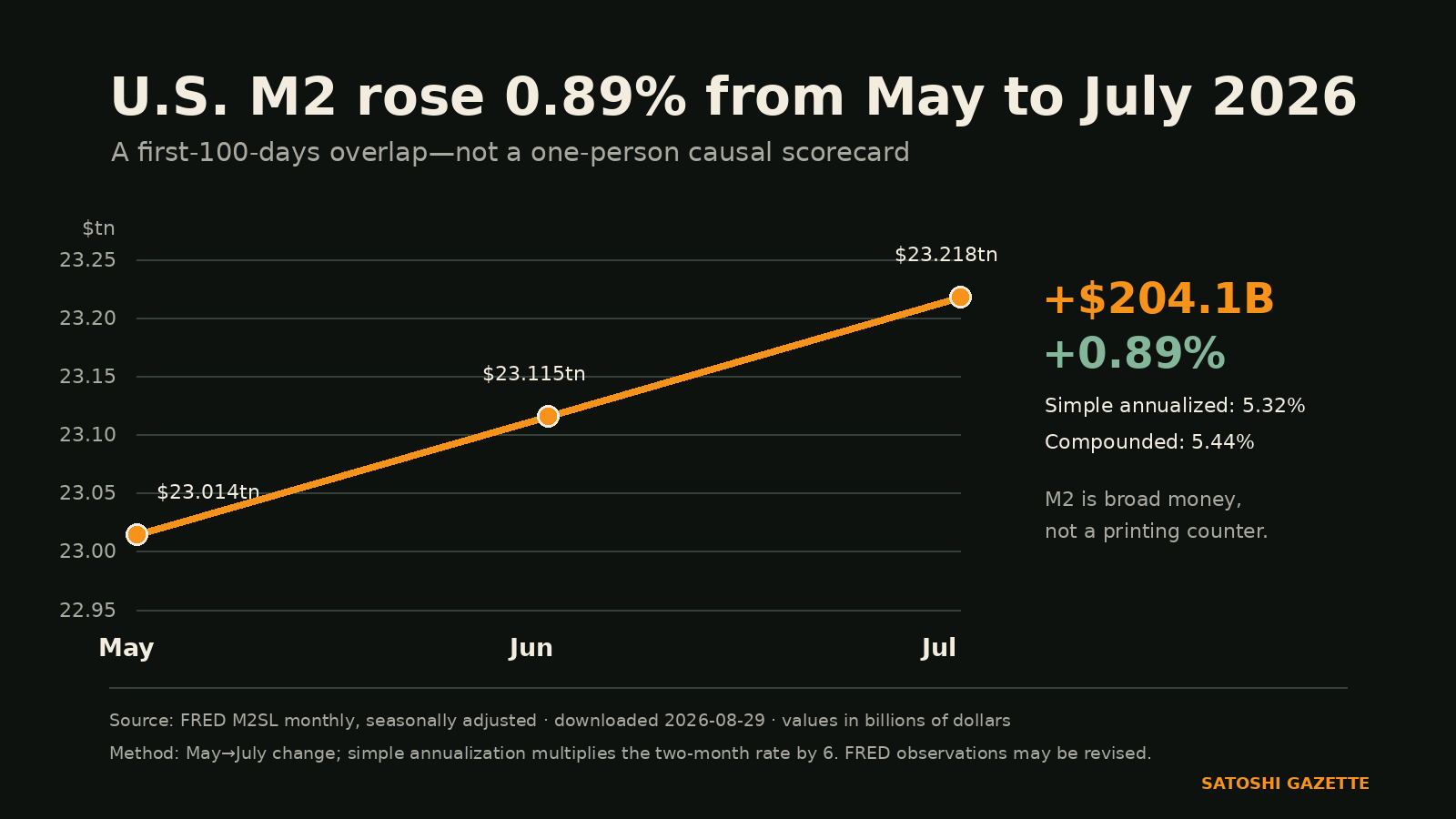
FRED's seasonally adjusted M2 series rose from 23,013.9 billion dollars in May to 23,218.0 billion in July: a 204.1 billion increase, or 0.8869 percent. Multiplying that two-month rate across six equal periods gives a simple annualized pace near 5.32 percent; compounding it gives roughly 5.44 percent. The May observation predates Warsh's May 22 swearing-in, so this is a first-100-days overlap, not a clean causal scorecard.
Method
Downloaded the complete FRED M2SL CSV on 2026-08-29, selected the 2026-05-01 through 2026-07-01 seasonally adjusted monthly observations, subtracted May from July, divided by May for the period percentage, multiplied the two-month rate by six for the simple annualized pace, and compounded the period return across six periods for the comparison rate. FRED observations may be revised, so a later download can differ from these values.
M2 is broad money, not a literal counter of dollars printed by the chair. Bank credit, deposits, portfolio choices and policy conditions all matter, and the series can be revised. Peter Schiff's post supplies a useful challenge; the official data supplies the number. Warsh himself acknowledged that both central-bank money and money from the banking and financial systems matter.
Bitcoin changes the governance question, not the uncertainty of life. Its subsidy follows a public 210,000-block halving rule toward a 21 million cap; no chair sets next month's issuance. That does not guarantee price performance, protect a careless custodian or eliminate software risk. It does mean the supply rule can be checked before the speech, after the speech and without trusting the speaker.