The Trump Dividend: $5,000 a Head From a Company That Owes $40 Trillion
Costed from the Census count and read against the Treasury's own ledger: the tariffs meant to pay for it have run negative since May, the ten-month deficit already beats last year's, the pledge would use every dollar of room under the debt limit, and the newest lender to this company is the stablecoin in your phone.
On Wednesday night in Dallas, closing the first day of the Republican midterm convention, Donald Trump made a promise with a condition attached. "If the Republicans win the House of Representatives and the United States Senate, both of them," he said, "I will issue a dividend to every adult citizen in the United States of America for $5,000. Very much like a successful company will do a cash distribution to its shareholders. Or like last year when I gave our great members of the military 1,776."
He added one caveat, as transcribed by several outlets: "the dividend that we're making must be spent in the United States of America. We don't want you going to Canada to spend the money." He did not say where the money would come from, who would be excluded, when it would be paid, or under what law. Asked by CBS Texas the next day whether Congress would have to approve it, he said: "We think not."
A dividend is what a successful company pays out of profit. So the first question is not political. It is the one any shareholder asks: how is the company doing?
The company owes $40 trillion
Method
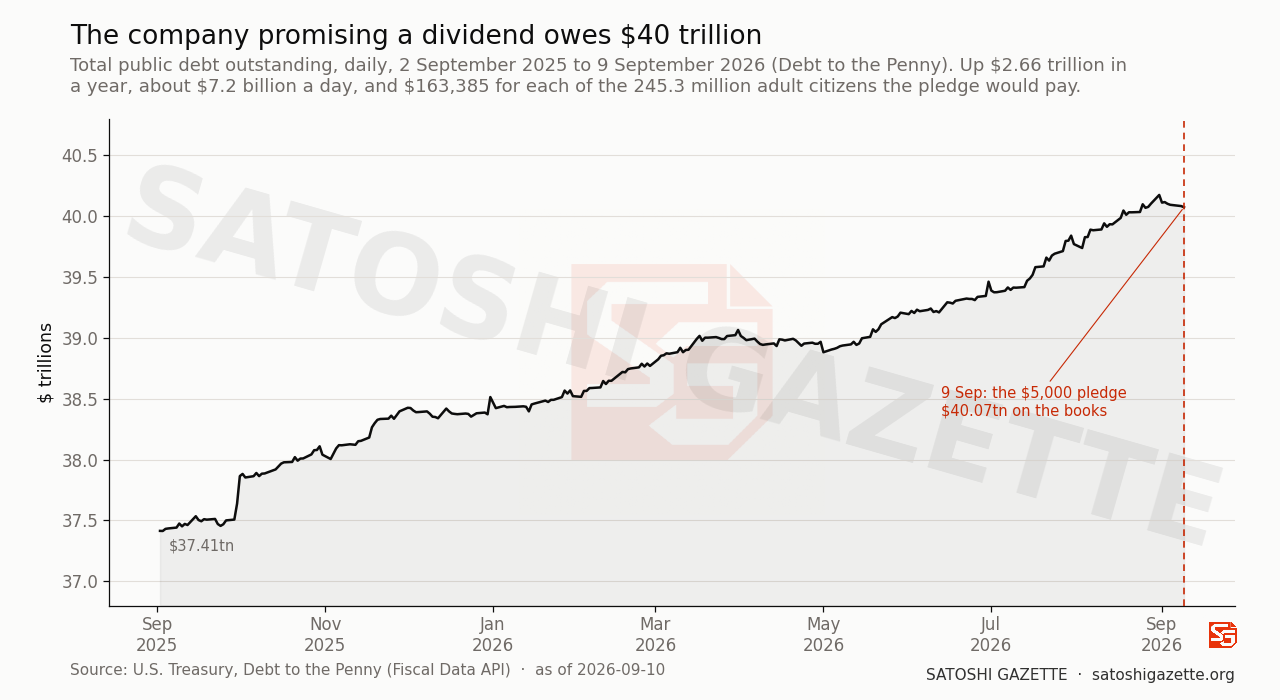
Every daily Debt to the Penny record from 2 September 2025 to 9 September 2026 read through the Fiscal Data API on 10 September 2026 and plotted without smoothing. The per-day figure divides the change by 372 calendar days; the per-adult figure divides the 9 September total by the ACS 2024 count of citizens aged 18 and over.
Total public debt outstanding was $40.07 trillion on 9 September, according to the Treasury's Debt to the Penny. A year earlier it was $37.41 trillion. That is $2.66 trillion of new borrowing in twelve months, about $7.2 billion every day including weekends, or $163,385 for each of the adult citizens the dividend would be mailed to. At that pace the Treasury borrows the entire value of the pledge every 172 days without calling it a gift.
The company also pays interest. Net interest for the first ten months of the fiscal year was $931 billion, up from $841 billion in the same months last year, per the July Monthly Treasury Statement. That is $3 billion a day. The Congressional Budget Office's August review, as summarised by the Committee for a Responsible Federal Budget, notes that interest now costs more than national defence.
The arithmetic
The Census Bureau's 2024 American Community Survey counts 245,275,126 citizens aged 18 and over. At $5,000 each, the pledge costs $1,226 billion. CRFB puts it at $1.2 trillion, about 3.5 percent of GDP, and its president, Maya MacGuineas, called it "fiscally dangerous, economically backwards, and fundamentally unserious." Vice President JD Vance told Fox News it was "fundamentally a dividend for American workers," which the press has read as a hint that high earners might be cut out. Trump himself set no income line, so the number stands.
The tariffs that were going to pay for it
Vance also told Fox News the money would come from tariff revenue. The Treasury's July statement shows what tariff revenue has actually done this fiscal year.
Method
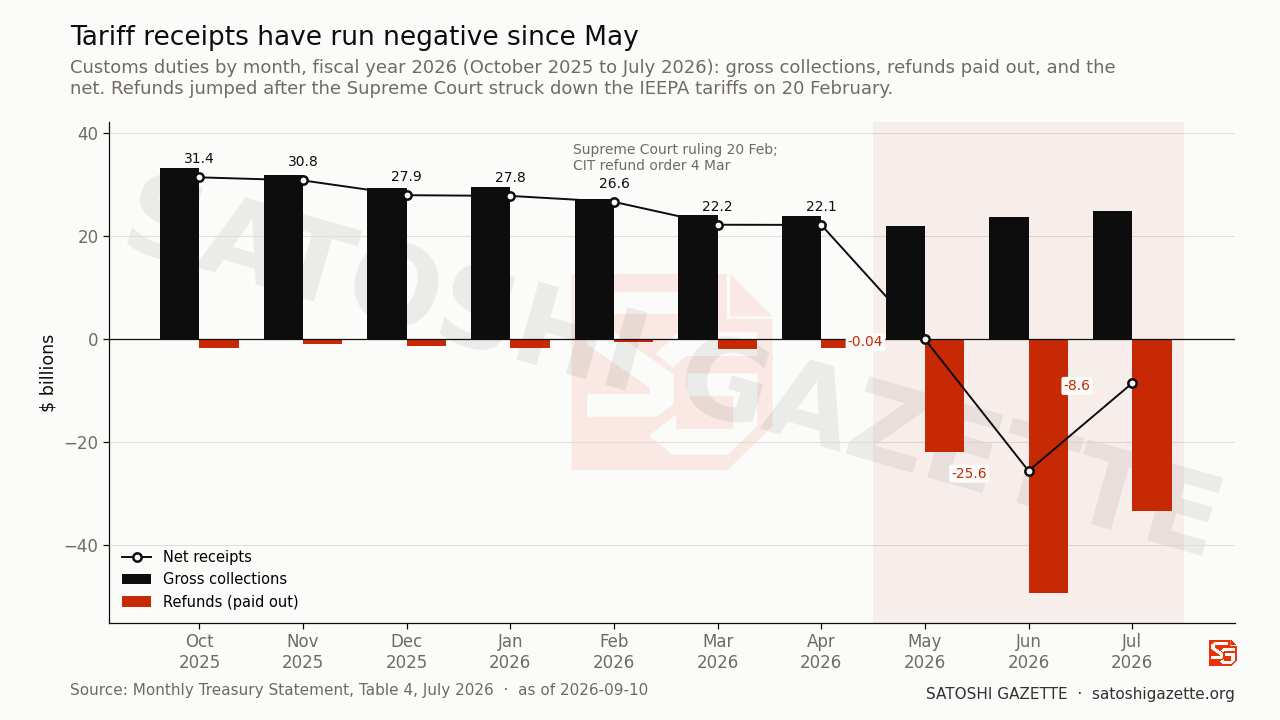
Values are the Monthly Treasury Statement Table 4 rows for Customs Duties, fiscal year 2026, read through the Fiscal Data API on 10 September 2026 and converted from dollars to billions at two decimals. Net is gross minus refunds as published. Shading marks the three net-negative months.
From October to July, customs duties brought in $269.2 billion gross. Over the same ten months the Treasury paid out $114.7 billion in refunds, leaving net receipts of $154.5 billion. The refunds are the consequence of Learning Resources, Inc. v. Trump, decided 6 to 3 on 20 February, in which the Supreme Court held that the International Emergency Economic Powers Act does not authorise the President to impose tariffs. On 4 March the Court of International Trade ordered Customs and Border Protection to return roughly $165 billion collected under those tariffs, according to a Skadden client memo on the refund mechanism.
In May, refunds slightly exceeded collections. In June, net customs receipts were minus $25.6 billion. In July, minus $8.6 billion. The funding source named on Fox News has been a cost centre for three months. Gross collections still run at about $24 billion a month, which annualises to roughly $290 billion, a quarter of the pledge before a single refund. CBO now expects tariff collections this year to fall about $250 billion short of its earlier projection for the same reason.
What it looks like on the ledger
Method
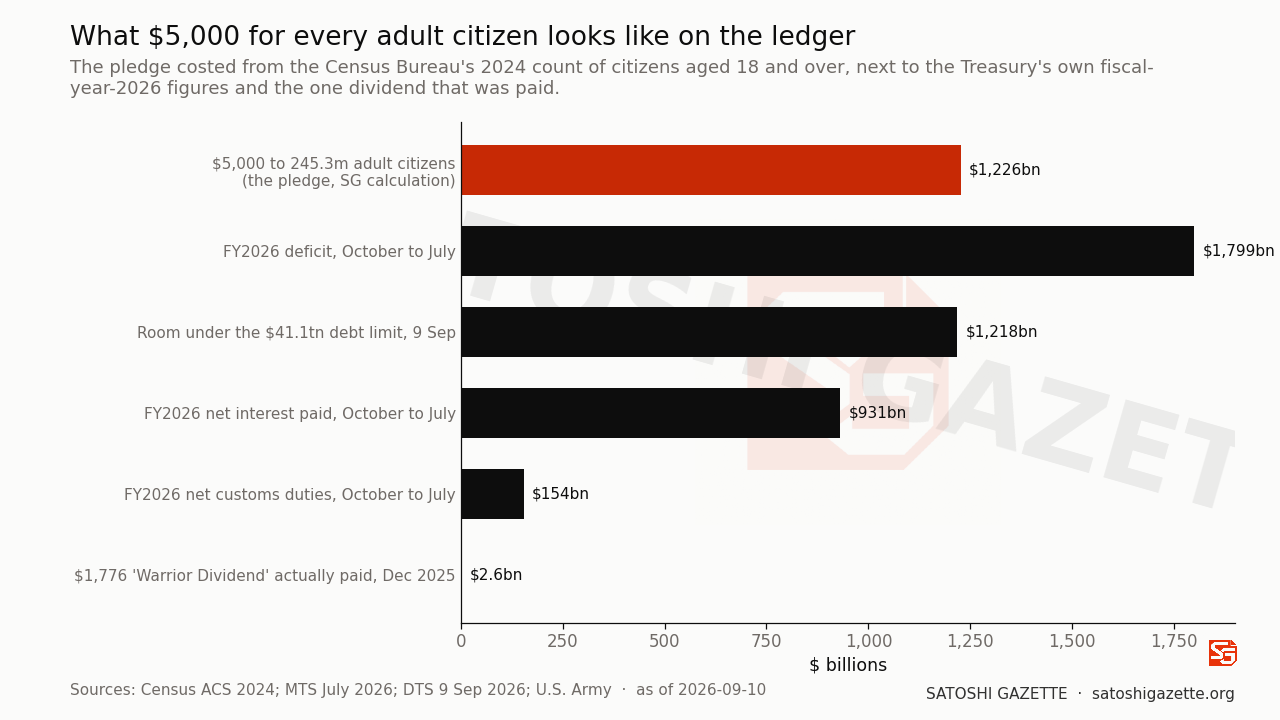
Pledge cost is 5,000 multiplied by the ACS 2024 one-year estimate of citizens aged 18 and over (245,275,126). Deficit, net interest and customs duties are Monthly Treasury Statement Tables 1, 9 and 4 for July 2026. Debt-limit room is the statutory limit minus debt subject to limit from the Daily Treasury Statement of 9 September 2026. The Warrior Dividend is 1,776 dollars times about 1.45 million service members per the Army's account. All read on 10 September 2026.
The July statement puts the deficit for the first ten months of fiscal 2026 at $1,798.8 billion, on receipts of $4,485.4 billion and outlays of $6,284.2 billion. That already exceeds the $1,775.4 billion deficit for all twelve months of fiscal 2025. CBO's estimate for eleven months is $2.0 trillion, with August alone at $168 billion.
Then the debt limit. The Daily Treasury Statement for 9 September shows debt subject to the limit at $39,886 billion against a statutory limit of $41,104 billion: $1,218 billion of room. A $1,226 billion dividend would use all of it and $8 billion more. The Constitution places spending with Congress, which is why "we think not" is a claim rather than a plan; no bill, draft or legislative text has been published. Republicans hold both chambers today. Nothing stops them appropriating $1.2 trillion this month, except that they would then have to vote for it.
Buying the midterms, or merely renting them
The words matter here, so we will use the statute's. Title 18, section 597 of the United States Code: "Whoever makes or offers to make an expenditure to any person, either to vote or withhold his vote, or to vote for or against any candidate" is guilty of a federal crime, with up to two years if wilful.
Election lawyers say the pledge probably does not meet it, and the reason is instructive. "This is a campaign promise," New Mexico election attorney John Day told the Associated Press. "It's not a payment to individuals to try to get them to vote in a particular way." The payment goes to everyone whether they vote or not. In other words, it is legal precisely because it is not targeted: the whole electorate is offered $5,000 for a collective outcome, which the law does not count as buying a vote because it is buying all of them at once.
There is precedent for cash with a name on it. In April 2020, IRS records obtained by ABC News show, Treasury Secretary Steven Mnuchin instructed the IRS to print "Economic Impact Payment / President Donald J. Trump" in the memo line of about 35 million paper stimulus cheques, the first time a president's name had appeared on an IRS disbursement. The 2026 version skips the cheque and prints the name on the promise.
The dividends that came before
This is at least the third universal cash promise of the term, and the record on the previous ones is on the public books.
In February 2025 Trump floated a "DOGE dividend," a share of savings from the Department of Government Efficiency. No payment was made. On 9 November 2025 he wrote on Truth Social that "a dividend of at least $2,000 a person (not including high income people!) will be paid to everyone" from tariff revenue. CRFB costed that at about $600 billion a round. No payment was made, and the tariff revenue in question is now being refunded to importers under a court order.
The one that was paid is the one he cited on stage. In December 2025 the Pentagon sent a one-time $1,776 "Warrior Dividend" to about 1.45 million service members, funded through the housing-allowance supplement in the One Big Beautiful Bill Act, according to the Army's own account. That is about $2.6 billion, or two tenths of one percent of the new pledge. One promise in three was kept, at a five-hundredth of the size.
The lifeline: a dollar that lends to the Treasury by law
How does a company that owes $40 trillion, loses $1.8 trillion in ten months and pays $3 billion a day in interest keep promising dividends? Because it has found a new class of shareholder who is required by statute to lend to it.
The GENIUS Act, Public Law 119-27, signed on 18 July 2025, requires every permitted issuer of a dollar stablecoin to hold reserves of at least one to one in a short list of assets: cash and Federal Reserve balances, insured deposits, and "Treasury bills, notes, or bonds with a remaining maturity of 93 days or less," plus repos and money-market funds built on the same paper. By law, a regulated digital dollar is a claim on short-dated government debt. The Treasury Secretary said the quiet part on signing day: stablecoins will "lead to a surge in demand for US Treasuries, which back stablecoins," and the law gives the market "the regulatory clarity it needs to grow into a multitrillion-dollar industry."
His own advisers had already done the arithmetic. The Treasury Borrowing Advisory Committee's April 2025 charge on "digital money" estimated that stablecoin issuers held more than $120 billion of Treasury bills and that the market could reach about $2 trillion by 2028, producing "materially heightened demand" for Treasuries. Tether, the largest issuer, reported $183.6 billion of USDT outstanding at 30 June against $187.75 billion of assets, "the majority" in U.S. government-backed instruments, and a $1.5 billion quarterly profit earned mostly from interest on that paper. Dollar stablecoins in total are about $311 billion, per DefiLlama.
Read that with the Dallas promise in one hand. Every person in Lagos, Buenos Aires or Istanbul who holds a digital dollar because their own currency is worse is, by construction, funding the Treasury that would mail $5,000 to American voters. The stablecoin is sold to the world as access to the dollar. On the Treasury's books it is a distribution channel for the debt. The lifeline runs to the borrower.
Why the money desk cares
This is a paper about keys, money and the exit, and this story is about money. A ledger with an issuer can promise 245 million people $5,000 eight weeks before an election, because the issuer decides what a dollar is and how many there are, and the bill is borrowed from whoever holds the currency, at home or abroad, whether they were asked or not. The interest on that borrowing already costs more than national defence, and it compounds.
Bitcoin cannot make you that promise. Nobody can: there is no issuer, the supply schedule is not on any ballot, and no one can be voted a dividend out of someone else's balance. That is the whole point of it, and it is the reason the ordinary holder of dollars, wherever they live, has more reason to understand it this year than last. The promise will be settled on 3 November. The ledger it would be drawn on is published every day at the Treasury, and anyone can read it.