The Rates Trade Ran Forward. One Hour Did the Day's Work.
Bitcoin rose 5.5 percent on September 3 and the two-year Treasury yield fell five basis points. Almost the whole move landed inside the 14:00 UTC hour that opened with the ISM services report, a release whose two halves argue against each other.

Two weeks ago Satoshi Gazette called bitcoin's 22 percent weekly rally a rates trade and named $80,000 as the test.Story This morning it reported the same trade running in reverse: oil above $90, the ten-year Treasury yield at its highest since 2023, and bitcoin falling alongside gold while stocks rose.Story
By the end of the same day the trade had run forward again. Almost all of it happened inside one hour.
The hour
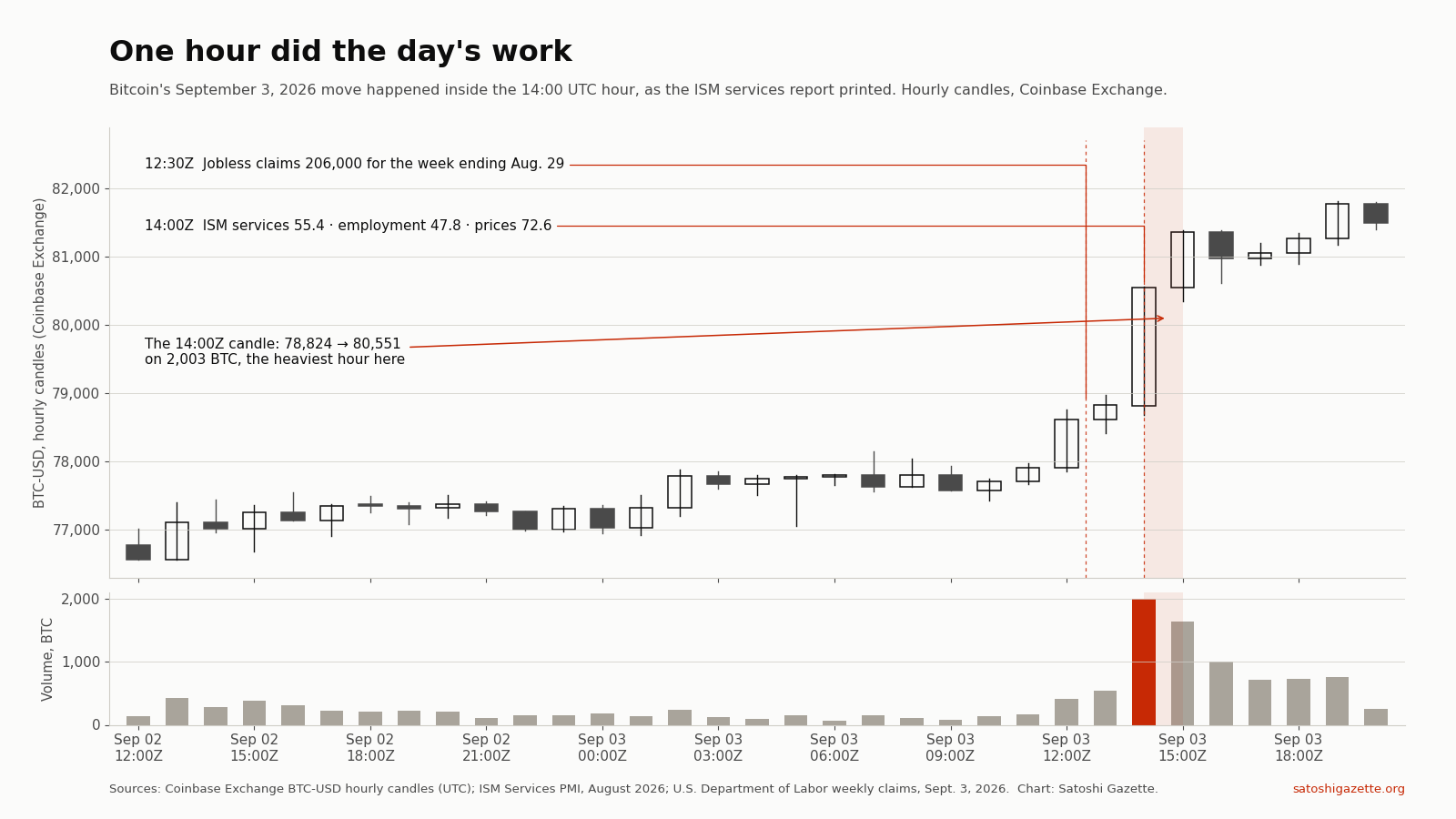
Bitcoin closed at $77,307 on Coinbase on September 2 and traded at $81,542 at 19:50 UTC on September 3, a rise of 5.5 percent with the daily candle still open.02
The path matters more than the level. Through the night and the European morning the price held between $77,000 and $78,000. The 13:00 UTC hour closed at $78,824. The 14:00 UTC hour closed at $80,551 on 2,003 bitcoin of volume, more than four times the volume of any other hour in the two-day window and the heaviest hour of either day. Every hour after it closed higher, and the session high of $81,645 came at 19:00.01
Roughly two-fifths of the day's gain arrived in sixty minutes.
Method
Hourly BTC-USD candles from the Coinbase Exchange public API for September 2 12:00 UTC to September 3 20:00 UTC, plotted as open-high-low-close with each hour's traded volume below. Release times are the ones stated in each official document: 8:30 a.m. ET for the Department of Labor claims release and 10:00 a.m. ET for the ISM services report, both converted to UTC. The 14:00 UTC hour is shaded. No smoothing, no fitting and no adjustment of any figure.
What printed in that hour
Two American data releases landed inside the window, and their times are on the record.
At 12:30 UTC the Department of Labor reported 206,000 initial jobless claims for the week ending August 29, an increase of 2,000 on a prior week revised up to 204,000. The four-week average was 207,250 and insured unemployment was 1,779,000.05 Claims at that level describe a labor market that is neither breaking nor tightening.
At 14:00 UTC, the hour of the move, the Institute for Supply Management published its August services report. The headline index read 55.4 against 54.1 in July, a twenty-sixth consecutive month of expansion.04
A strong services headline is not, by itself, a reason for bitcoin to rise. What sits underneath it is the part worth reading. The employment index printed 47.8, below the 50 line for a second consecutive month. The prices index printed 72.6, above 70 for the fifth time in six months.
That is a report pointing in two directions at once. Contracting services employment is the kind of number that lowers the odds of another rate increase. A prices index in the seventies is the kind that raises them. Both were in the same release, and Satoshi Gazette cannot establish which line the market traded on.
The bond market's answer
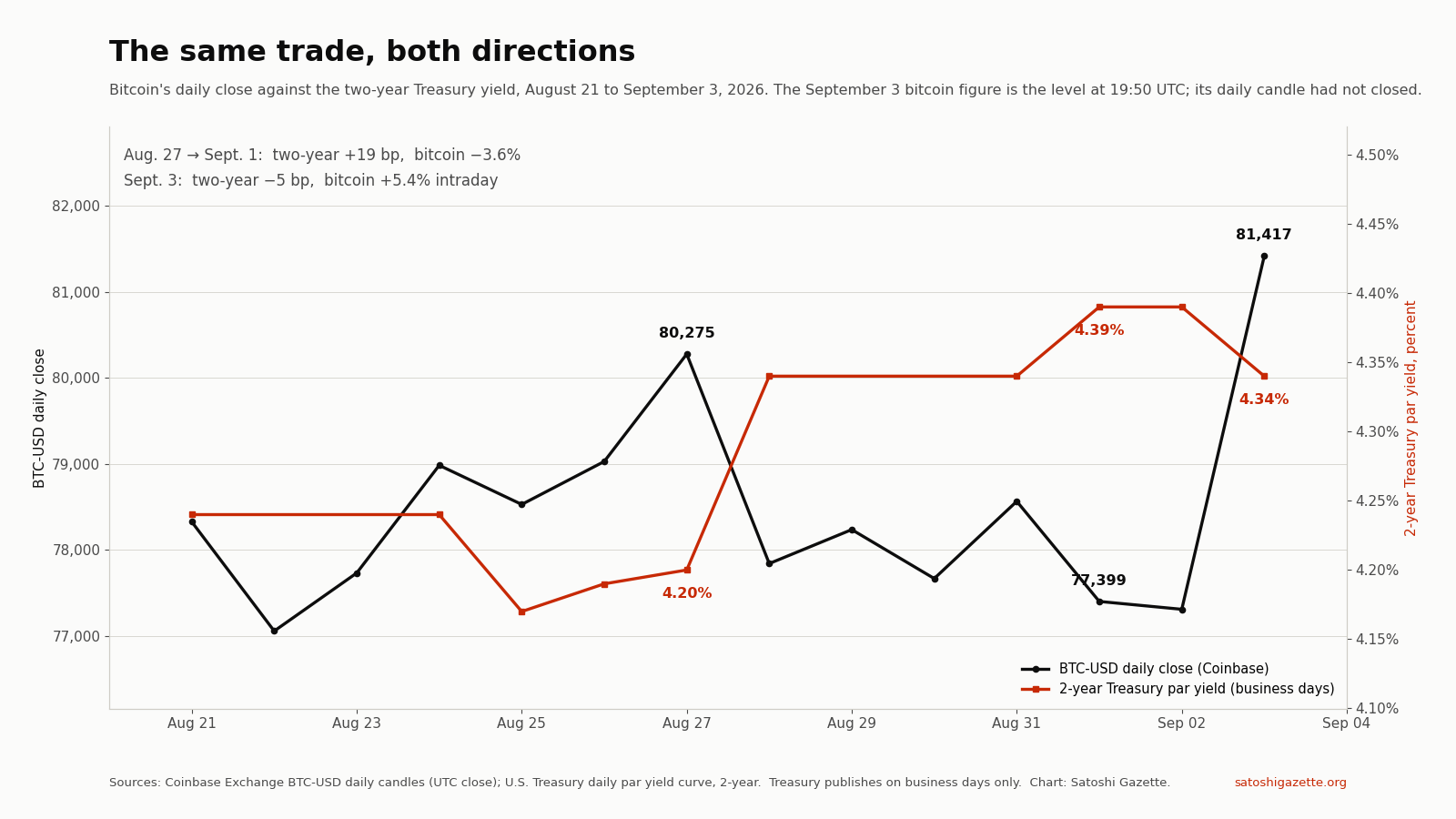
What the bond market did with it is not in dispute. Treasury's own par yield curve records the two-year note, the maturity most sensitive to Federal Reserve expectations, falling from 4.39 percent on September 2 to 4.34 percent on September 3. The ten-year fell from 4.79 to 4.77, the thirty-year from 5.27 to 5.25.03
The two-year is now back exactly where it sat on August 28, before the escalation this morning's Story described.
Set the two episodes side by side. Between August 27 and September 1 the two-year rose 19 basis points and bitcoin fell 3.6 percent. On September 3 the two-year fell 5 basis points and bitcoin rose 5.5 percent. The direction reversed. The relationship did not.
Method
Daily BTC-USD closes from the Coinbase Exchange public API on the left axis against the two-year constant-maturity par yield from the U.S. Treasury daily yield curve on the right, August 21 to September 3, 2026. Treasury publishes on business days only, so the yield line connects consecutive published observations and does not interpolate weekends. The September 3 bitcoin point is the 19:50 UTC level rather than a settled close, and the chart says so. Axis ranges are set to the observed data with padding; neither series is rebased or scaled.
The policy voice, on the same day
Governor Christopher Waller spoke at a Reuters interview in Washington on September 3. He described the labor market as "in satisfactory shape," with job creation averaging 60,000 a month through July and unemployment at 4.1 percent, and noted that three-month core inflation has "fallen steadily from 4.76 percent in February" while the twelve-month rate remains 3.7 percent.
On the September 15 and 16 meeting he was specific in both directions. "If this continues in the data due over the next two weeks, I would be inclined to support holding the target for the federal funds rate at its current setting," he said. And: "But if inflation comes in hot, I would consider a rate hike."06
One governor is not the Committee. But a sitting governor putting a hold on the table, on the day the two-year fell, belongs in the record of what moved.
The money that was already moving
Flows do not explain a single hour, and they are reported a day behind. They do show the direction of the week. United States spot bitcoin exchange-traded funds took in $101.15 million on September 2, led by $115.45 million into BlackRock's fund, after $236.5 million left the group on September 1.07
The holdings file behind the largest of those funds is more durable than a daily flow estimate. It shows 778,729.91 bitcoin as of September 2, about 7,089 more than the 771,641 recorded on the Satoshi Gazette custody page for August 25.08
What this means if you hold bitcoin
The August reading survived its test in both directions, which makes it more useful than it was two weeks ago. Bitcoin is trading as a long-duration asset priced off the discount rate. When the market's expectation of the policy path moves, bitcoin moves against it, and the move arrives in the minutes around the data that changes that expectation rather than spread across the day.
That has three practical consequences. The calendar matters more than the chart: the August jobs report and the September 15 and 16 meeting will do more to the price than anything on-chain. Leverage held through a data print is a bet on a coin flip whose timing is public. And a rally that arrives in one hour on one release can leave the same way, on the next one.
None of this touches the properties the desk usually writes about. Issuance did not change today. Nobody's keys changed hands. The network produced blocks on its ten-minute schedule while the price moved 5 percent, which is the ordinary condition of a monetary asset trading inside somebody else's rate cycle.
What Satoshi Gazette cannot say
It cannot say the ISM report caused the move. The timing is exact and it is on the record, and that is all timing establishes. Another explanation, unrecorded, could have arrived in the same hour.
It cannot say which half of the ISM report the market read, and the two halves argue against each other.
It cannot settle the day's close. The figures above are the level at 19:50 UTC with the daily candle open, and the September 3 flow numbers publish after the American close.
The next tests are dated. The August employment report arrives on Friday, and the Committee meets on September 15 and 16. If the relationship holds, the price will tell you what the market thinks of both before any commentary does.