Keep the Bitcoin, Lose the Keys: Inside Better and Coinbase's Mortgage
The product avoids a sale and price-triggered margin calls, but it adds a second loan, a second lien and lender custody of 250% Bitcoin collateral.

Better's pitch is simple: buy a home without selling your Bitcoin. The actual product is more complicated, and the complication is where the story lives.
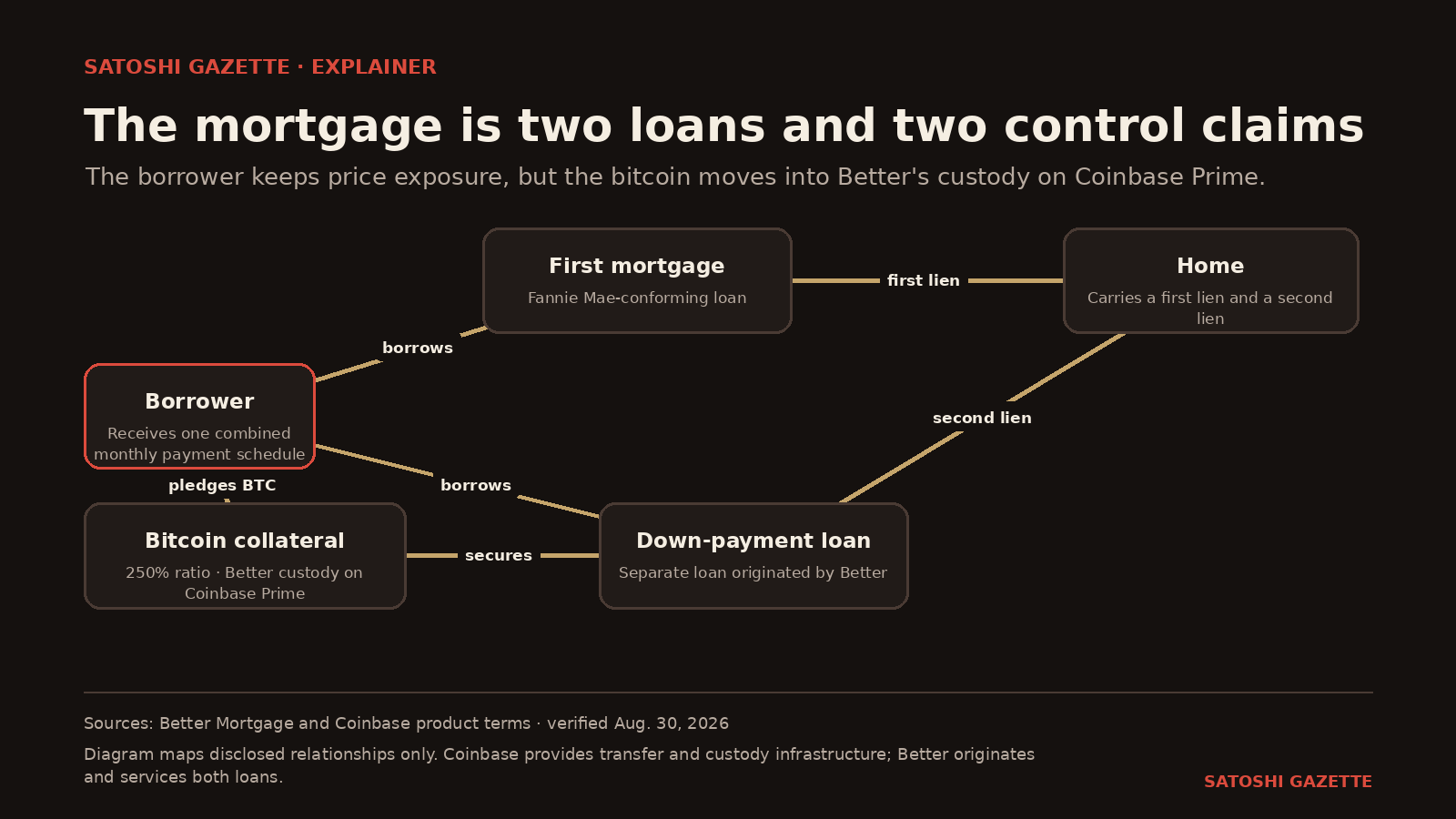
A borrower receives two loans. The first is a standard Fannie Mae-conforming mortgage secured by the home. The second funds the cash down payment and is secured twice: by pledged Bitcoin and by a second lien on the same home. Better originates both loans. Coinbase provides the transfer and custody infrastructure, but does not originate or service the mortgage.
The Bitcoin must be worth at least 250% of the down-payment loan. Put another way, each $1 of that loan requires $2.50 of Bitcoin collateral. Better's own example uses $250,000 of Bitcoin to support a $100,000 down-payment loan on a $500,000 home.
Method
Map only relationships explicitly stated by Better and Coinbase: borrower, first mortgage, down-payment loan, home liens, Bitcoin transfer and custody. Show the 250% collateral ratio as a label, not an inferred valuation. Do not depict Coinbase as lender or servicer.
The borrower does not keep the keys. After approval, the pledged bitcoin moves from the borrower's Coinbase account into Better's custodial account on Coinbase Prime. It stays under Better's control until the applicable loans are repaid or refinanced under the final terms. The borrower keeps the economic exposure, including potential appreciation, but not the ability to move, spend or independently custody those coins.
The product removes one familiar danger of Bitcoin-backed lending. A fall in Bitcoin's market price does not by itself trigger a margin call, a collateral top-up or an automatic sale. The high starting collateral ratio absorbs volatility instead.
It does not remove liquidation risk. Better says that if a borrower remains delinquent for 60 days, it may liquidate the pledged Bitcoin. Foreclosure on the home follows a separate timeline and may begin at day 180. Avoiding a price-triggered sale is meaningful, but payment failure can still put both the collateral and the property at risk.
There is a real use case here. A Bitcoin holder may want a home more than a taxable sale, may not have a matching pile of cash and may judge the cost of two loans worth paying. The product also gives borrowers a way to retain upside exposure without the recurring top-up demands common to margin lending. Those benefits should not be dismissed merely because an institution provides them.
They should not be confused with self-custody either. The structure converts bearer money into lender-controlled collateral and adds leverage against a home. Its promise depends on Better's servicing, Coinbase Prime's infrastructure, contract enforcement and the borrower's continuing ability to pay. The borrower has not sold the Bitcoin, but has surrendered its use and control.
That is the more honest way to read institutional Bitcoin adoption. It can make an asset useful inside traditional finance while changing the very property that made the asset different. For some borrowers, that trade may be rational. It is still a trade, and 'keep your Bitcoin' describes only half of it.
This article explains disclosed product terms and is not financial, tax or legal advice. Borrowers should review their own final loan and custody documents rather than relying on promotional examples.