IREN Is Leaving Bitcoin Mining for AI. The Power Does Not Leave With It
The company cut installed mining capacity from 38 EH/s in March to 23.2 EH/s in June, took $638.8 million of impairments and says its mining wind-down should be substantially complete by year-end.
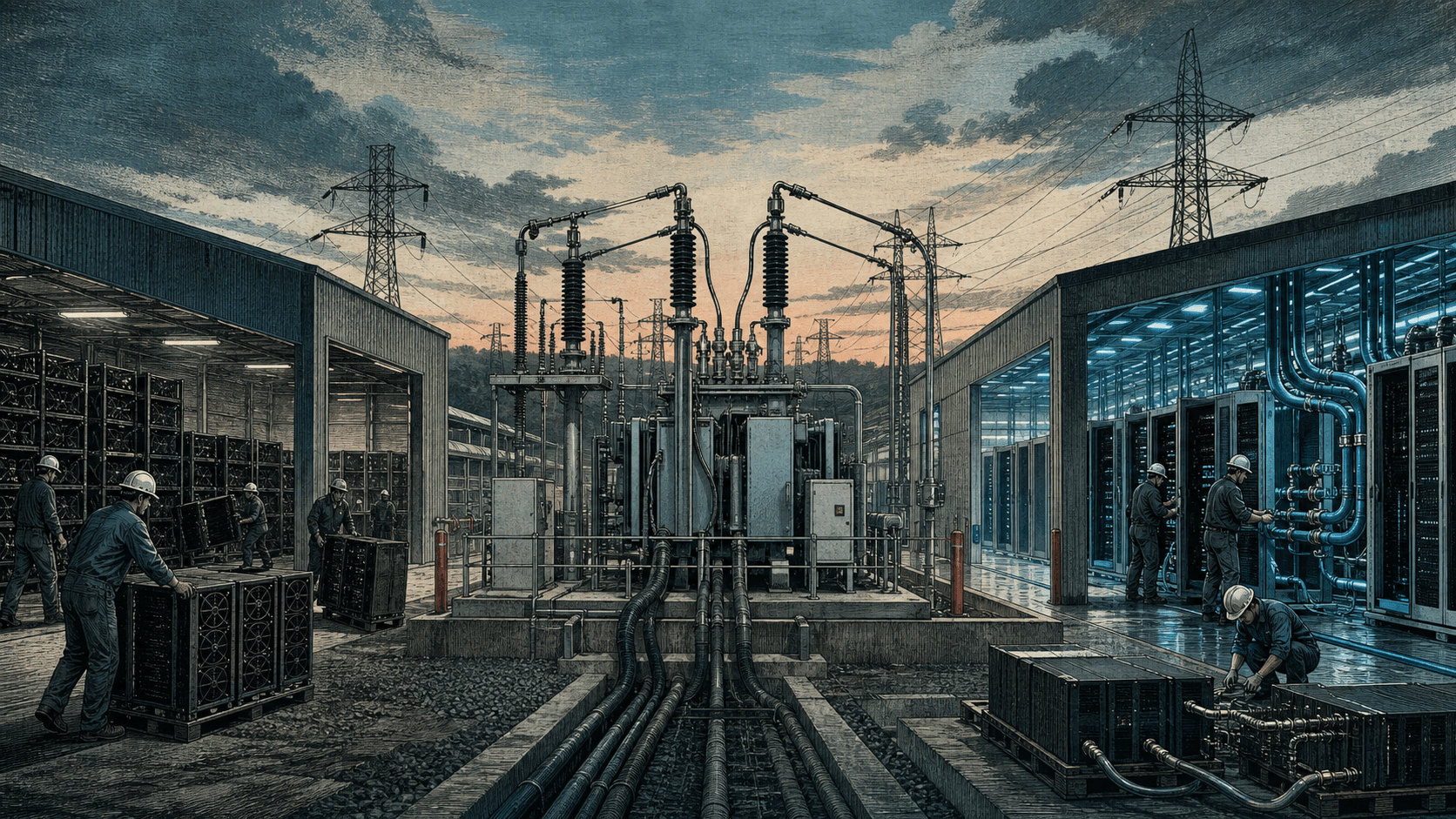
IREN is no longer describing artificial intelligence as a side business attached to a Bitcoin miner. Its latest annual filing says the company aims to substantially complete its transition from Bitcoin mining to AI cloud services by December 31, 2026. The machines can leave. The grid connections, substations and power contracts stay.
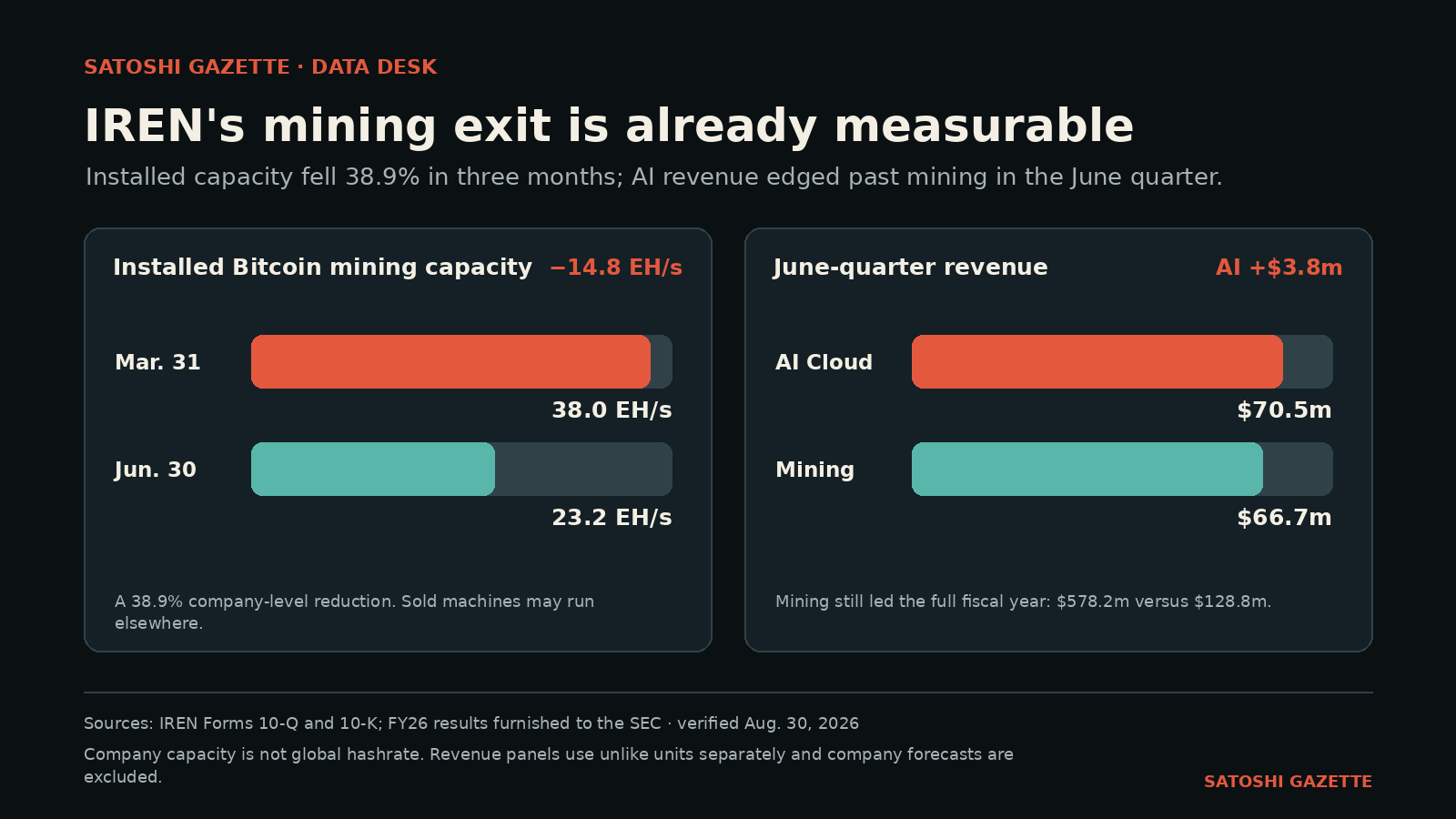
The change is already visible. IREN reported 38 EH/s of installed mining capacity at March 31 and 23.2 EH/s at June 30, a decline of 14.8 EH/s, or 38.9%, in three months. The remaining June capacity occupied about 380 MW. IREN also says it liquidates the bitcoin it mines each day and held none on its balance sheet at year-end. This was an operating business, not a treasury strategy.
The revenue crossover arrived in the June quarter. AI cloud services produced $70.5 million, slightly more than Bitcoin mining's $66.7 million. That single quarter does not erase the old business. Across the full year, mining still produced $578.2 million against $128.8 million from AI. But the direction of travel is hard to miss.
Method
Transcribe the installed-capacity observations from IREN's March 31 10-Q and June 30 10-K; subtract June from March and divide by March. Transcribe the June-quarter segment revenue from IREN's FY26 results exhibit. Render the two comparisons in separate panels so unlike units are never placed on one axis.
It is expensive to change what a data center is for. IREN recorded $638.8 million of impairments for the year, primarily tied to mining hardware and related infrastructure being decommissioned for AI growth. It also recorded a $110.6 million reduction in the value of miners held for sale. Those are accounting figures, not a count of dead machines, and some ASICs may be sold and run elsewhere. A fall in IREN's installed capacity therefore cannot be read as an equal loss to global hashrate.
What the filing does show is where the scarce asset sits. IREN's pitch to AI customers rests on land, substations, liquid cooling and more than 5 GW of executed or prospective grid-connected power across several countries. Bitcoin mining helped make that infrastructure productive before hyperscalers and AI labs were ready to pay more for it. Now those same sites are being reassigned to customers with multi-year contracts.
That shift matters beyond one stock. Bitcoin miners are often discussed as if their principal assets were ASIC fleets. In practice, access to power, permission to connect large loads, financing and the ability to build at scale can be harder to replace than the computers. If AI continues bidding more for those assets, hashrate may migrate toward operators and jurisdictions that cannot earn more by serving a different buyer. That could change mining geography even if the network's total hashrate keeps growing.
There is also a revealing contrast between the two businesses. An AI data center needs customers, contracts and continuing demand for a particular kind of compute. A Bitcoin miner can point compatible machines at an open network and receive whatever the protocol and fee market pay. Permissionless revenue does not guarantee good economics. Contracted revenue does not guarantee independence. IREN is choosing the buyer that currently offers more value per megawatt.
The company may execute exactly as planned, and its AI forecasts may prove right. They remain management forecasts, not completed results. The verified fact is narrower and more useful: one of the largest listed mining operators is writing down mining equipment, reducing installed hashrate and treating grid-connected power as the business it wants to keep.