Central Banks Stopped Buying Treasuries in 2021. Private Money Bought Everything Since.
A letter from Norway became a claim that the world is dumping US government debt. The letter does not say that. But the comfortable answer — foreign holdings are at a record — is wrong about the thing that matters. The buyer changed.

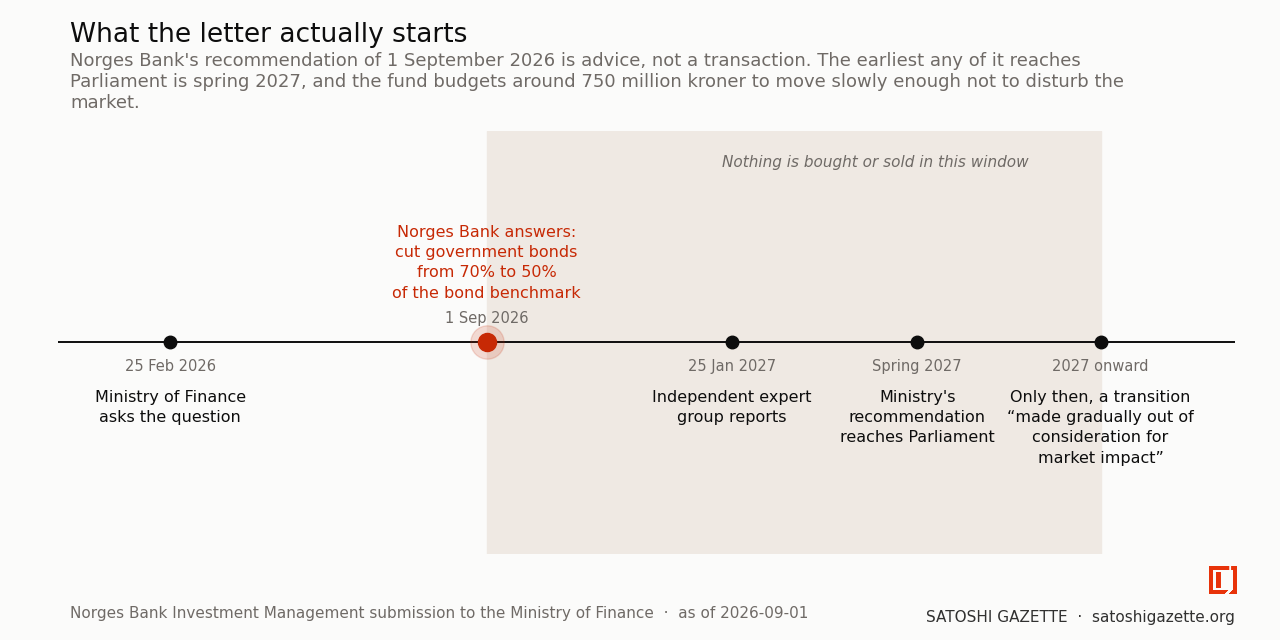
On 1 September, Norway's sovereign wealth fund sent the Ministry of Finance a letter answering a question the Ministry had asked in February. It recommended that government bonds fall from 70 to 50 percent of the fund's bond benchmark, with the rest going into corporate bonds, an expanded government-related segment, and securitised debt — mortgage-backed securities, mostly, which the fund does not currently hold.01
Within hours it was a claim that the world's largest sovereign fund is dumping $80 billion of US Treasuries.
It is not doing that, and the letter says so in the plainest possible terms. Norges Bank writes that it will "revert with a specific proposal for how the bond index should be specified in the mandate once the Ministry has taken a position on the advice." An independent expert group appointed by the Ministry reports by 25 January 2027. The Ministry then goes to Parliament in the spring. Any transition, the bank says, would be "made gradually out of consideration for market impact," and it budgets around 750 million kroner as an upper limit on the one-time cost of making it.
A fund that sets aside money to avoid moving a market is doing the opposite of dumping into one.
Method
Dates taken from Norges Bank Investment Management's submission of 1 September 2026 and its own description of the process that follows. The spring 2027 parliamentary step is the date the submission gives; no date is assigned to the transition itself because none is stated.
The dollar figures attached to the story are worth even less than the verb. The recommendation moves a benchmark share. The fund's actual government bond holding is 54.9 percent of its fixed-income portfolio, not 70.05 At 30 June the whole government bond book was about $360 billion, which is the number any claim about cutting $80 billion or $106 billion needs to be read against — and different outlets published both. Nor is the fund the same thing as the $203.2 billion the US Treasury records against "Norway," which counts every Norwegian holder by where the securities are custodied.
None of which means nothing is happening. Something is, and it is more interesting than the version going around.
The comfortable answer is also wrong
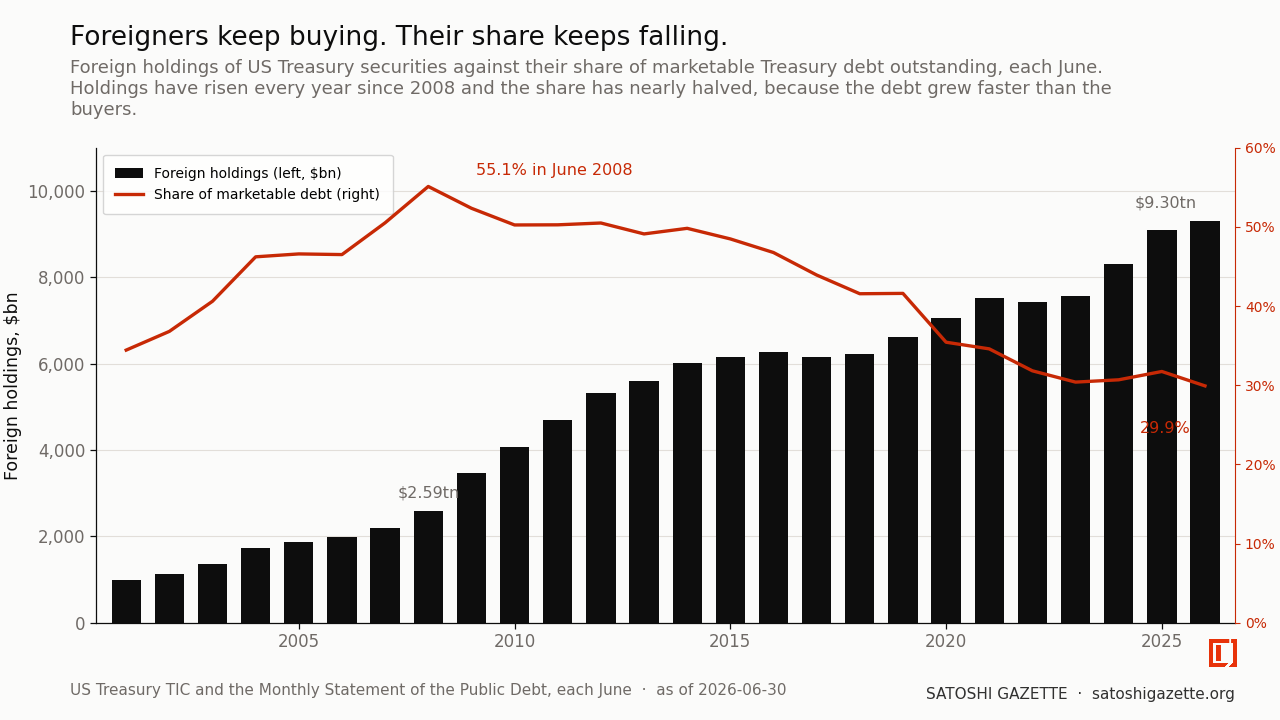
The standard correction to "the world is dumping Treasuries" is to point at the total. Foreign investors held $9,299.0 billion of US Treasury securities at the end of June, close to the most ever.03 Nobody is leaving.
That is true and it settles nothing.
Run the number against the debt it is financing. Marketable Treasury debt outstanding was $31,085.8 billion at the same date.06 Foreign holders own 29.9 percent of it. At the June 2008 peak they owned 55.1 percent.
Foreign investors have bought $6.7 trillion more Treasuries since 2008 and watched their share of the market nearly halve. The debt grew 6.6 times over. Their holdings grew 3.6 times. They did not step back. They were outrun.
Method
Foreign holdings at end of June each year from the US Treasury's TIC Major Foreign Holders table. Marketable debt outstanding for the same month from the Monthly Statement of the Public Debt, security type Total Marketable. The share is the first divided by the second. No smoothing and no estimation.
So both stories are wrong, and they are wrong in a way that hides the same thing.
Who actually stopped
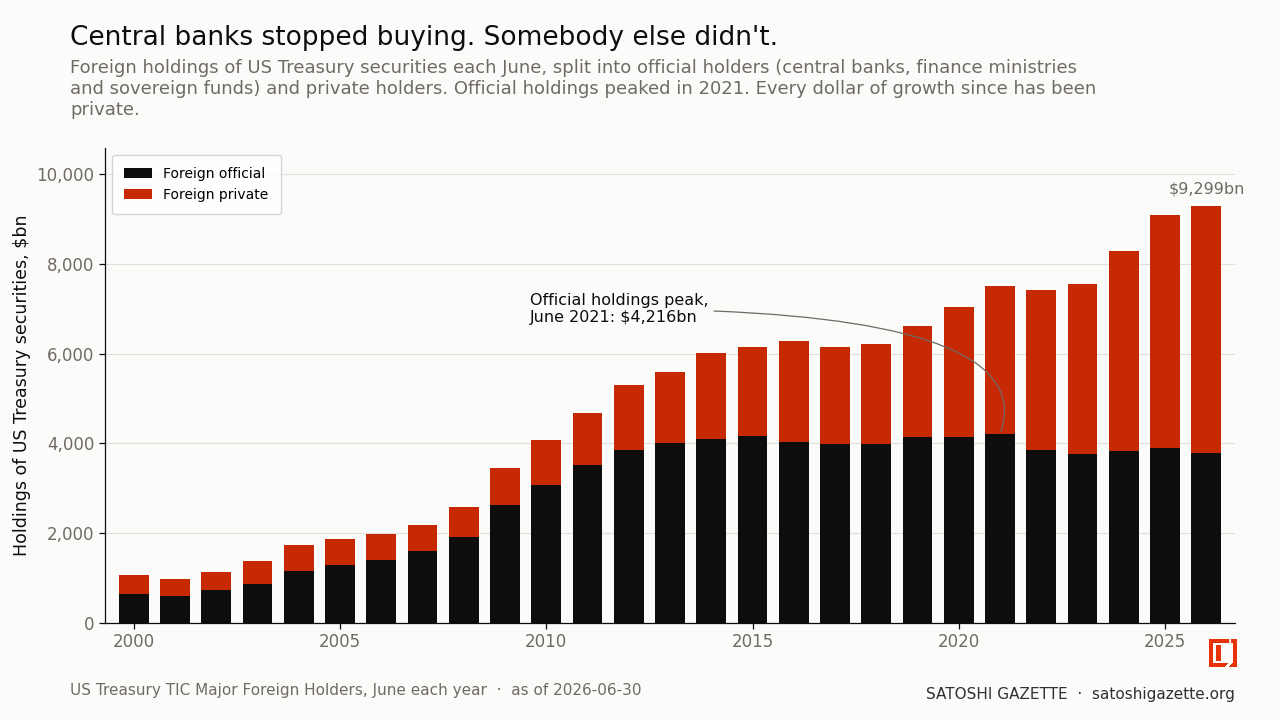
Treasury publishes the one split that answers it. Foreign holdings divide into official holders — central banks, finance ministries, sovereign wealth funds, money held for policy reasons — and everyone else.
Method
Holdings at end of June each year from the US Treasury's TIC Major Foreign Holders table, in billions of dollars. Official holdings are the table's own 'Of Which: Foreign Official' line, covering central banks, finance ministries and sovereign wealth funds; private holdings are the grand total less that line. Figures for 2000 to 2025 come from the TIC historical file, and June 2026 from the current table. No smoothing, no estimation, no adjustment of any figure.
Official foreign holdings peaked in June 2021 at $4,215.9 billion. Today they are $3,778.1 billion: down $438 billion over five years, in a period when the debt they might have financed grew by more than $11 trillion.
Private foreign holdings over those same five years went from $3,303.0 billion to $5,520.9 billion. Up $2,218 billion.
In 2023, for the first time in a series that runs back to 2000, private foreign holders passed official ones. Official money was 73.9 percent of foreign Treasury holdings in 2008. It is 40.6 percent now.
The central banks did step back. That half of the argument was right, and the record-holdings rebuttal papers straight over it. But foreign holdings hit records anyway, because private money took everything the official sector declined and then some. That half was right too.
What neither noticed is that the buyer changed.
Two things you have probably been told that are not true
You may have seen that 74 percent of central banks plan to cut their US Treasury holdings over five years. The number is real and the sentence around it is not. It comes from the World Gold Council's 2026 survey of 76 central banks, conducted between February and May, and the question it answers was this: "What proportion of total reserves (foreign exchange and gold) do you think will be denominated in US dollars 5 years from now?"07
Read it again. It asks about dollars, not Treasuries — the survey does not mention Treasury securities anywhere. It asks what respondents think will happen, not what they intend to do. And it asks about a proportion, whose denominator is stated in the question as foreign exchange and gold.
That last one matters more than it looks. If gold appreciates and nobody sells a single dollar, the dollar's share of that total falls anyway. Some unknown part of that 74 percent is not a view about the dollar at all. It is a view about the price of gold.
Which is the same trap in the other claim you have probably seen: that gold has overtaken US Treasuries as the world's largest reserve asset. It has, by market value. The IMF's own note is that most of the crossover came from the gold price rising rather than central banks selling Treasuries to buy an equivalent quantity of gold. A repricing is not a rotation.
And then there is what the reserves actually did while everyone was forecasting what they would do. The IMF's own measure of the currency composition of official reserves put the dollar at 57.13 percent in the first quarter of 2026, up from 56.42 percent the quarter before. The euro fell to 20.03 percent. The renminbi, the supposed successor, sits at 1.99 percent.04
The IMF is careful about why, in a way the people quoting it are not: "exchange-rate-driven valuation effects accounting for around half of the increase in its share." The dollar rose against other currencies, so dollar reserves were worth more in the comparison. Half of the move is arithmetic, not allocation.
Which is, once again, the same effect. When the number goes the way you like, it is a rotation. When it goes the other way, it is valuation. It was valuation both times.
What this means if you hold bitcoin
Not that the price goes up. Nothing here says that, and anyone who tells you a Treasury auction chart is a bitcoin chart is selling something.
What it says is narrower and more useful. The largest borrower in the world used to be financed at the margin by institutions that bought its debt for reasons that had little to do with the return: reserve adequacy, currency management, the plumbing of trade. Those institutions stopped growing their position five years ago. The gap has been filled by private money, which is there for the yield, and which is under no obligation to stay when the yield stops compensating it.
That is not a prediction of a crisis. It is a change in the character of the debt's owner, and it is the sort of change that only shows up when something is tested.
It is also the argument for holding an asset whose supply schedule is not a matter of anyone's willingness to keep buying. Bitcoin's 21 million does not need a marginal purchaser to remain 21 million. That is the whole claim, and it is a smaller claim than the ones being made with this data.
Norway sent a letter about a benchmark. Everything else in this story was already in the record, published monthly, free, and unread.