Block Sells Self-Custody. It Just Asked to Become the Custodian.
Builders Bank & Trust would move Cash App's bitcoin custody under an OCC charter. The public filing says what the bank would do, and nothing about how it would hold the keys.
On 8 September Block, Inc. said it had asked the Office of the Comptroller of the Currency to charter Builders Bank & Trust, N.A., an uninsured national trust bank that would hold bitcoin and stablecoins for Block and its customers. The transmittal letter, filed by Davis Polk and dated 4 September, calls it a de novo national trust bank sponsored by Block. It would take no deposits and make no loans. It would hold keys.
The application's public volume, twenty pages posted on Block's investor site, is precise about what the bank would do and silent about how. That gap is the story.
What Block already holds
Block does not need a bank to custody bitcoin. It already does, at scale. The application says the company runs its digital-asset business under more than fifty state money-transmitter and virtual-currency licences, facilitated roughly $10.7 billion of bitcoin transaction volume in fiscal 2025, and serves about two million digital-asset monthly transacting actives through Cash App as of the second quarter of 2026.
The bank's first job, in the application's words, is "custody and safekeeping of bitcoin and other digital assets, consolidating Block's existing bitcoin custody operations under a federally chartered trust bank framework." It would also execute customer buy and sell orders on a riskless-principal basis, carry out deposit, withdrawal and transfer instructions, and run stablecoin settlement and transfer.
So the coins are not moving anywhere new. The supervisor is. Today the custody sits under state licences; the proposal puts it under the OCC, exercising fiduciary powers the application grounds in 12 U.S.C. § 92a and § 24(Seventh). The press release says the same thing in one line: the charter "would establish a federal supervisory framework for certain custody and related activities currently offered by Block."
The terms a Cash App holder has now
Block's most recent quarterly report, for the quarter ended 30 June 2026, describes the arrangement the trust bank would inherit. Cash App customers may store bitcoin in Block's wallets free of charge. Block "holds the cryptographic key information and maintains the internal recordkeeping of the bitcoin held for other parties." Customers retain legal ownership and may sell, pledge or transfer.
Then the sentence that matters for anyone whose bitcoin lives in that app: "The customer also bears the risk of loss as a result of fraud or theft, unless the loss was caused by the Company's gross negligence or the Company's willful misconduct."
Block says it does not lend or pledge customer bitcoin, does not use it as collateral, and "occasionally engages third-party custodians to store and safeguard bitcoin on the Company's behalf." The filing does not say how much customer bitcoin it holds. Block's own investment holding is a separate line: 9,117 BTC at 30 June, tracked in the Gazette's treasury ledger.
Whether that risk-of-loss clause survives inside a fiduciary bank is the question a holder should want answered. The public application does not answer it.
What the public record leaves out
Everything about mechanics is in a confidential exhibits volume for which Block has requested Freedom of Information Act exemption: the business plan, the information-security programme, the list of outsourced functions and vendors, the capital figures, the request to exercise fiduciary powers, and the articles and bylaws. The public volume says the bank will be fully capitalised by Block with no borrowing during its three-year de novo period, and that it will maintain "adequate capital reserves" under OCC guidance. It gives no number.
A few structural facts are public. The bank would sit in Sioux Falls, South Dakota, with no branches, offering everything electronically nationwide. None of its five proposed directors lives in South Dakota or within a hundred miles of it, so Block has asked the OCC to waive the residency requirement. As an uninsured, non-depository trust bank it would carry no FDIC cover and would not be subject to the Community Reinvestment Act. Lee Woolley, Block's digital-asset strategy lead and a former Northern Trust and BNY Mellon banker, would be chair, chief executive and chief fiduciary officer.
Twelve ahead of it in the queue
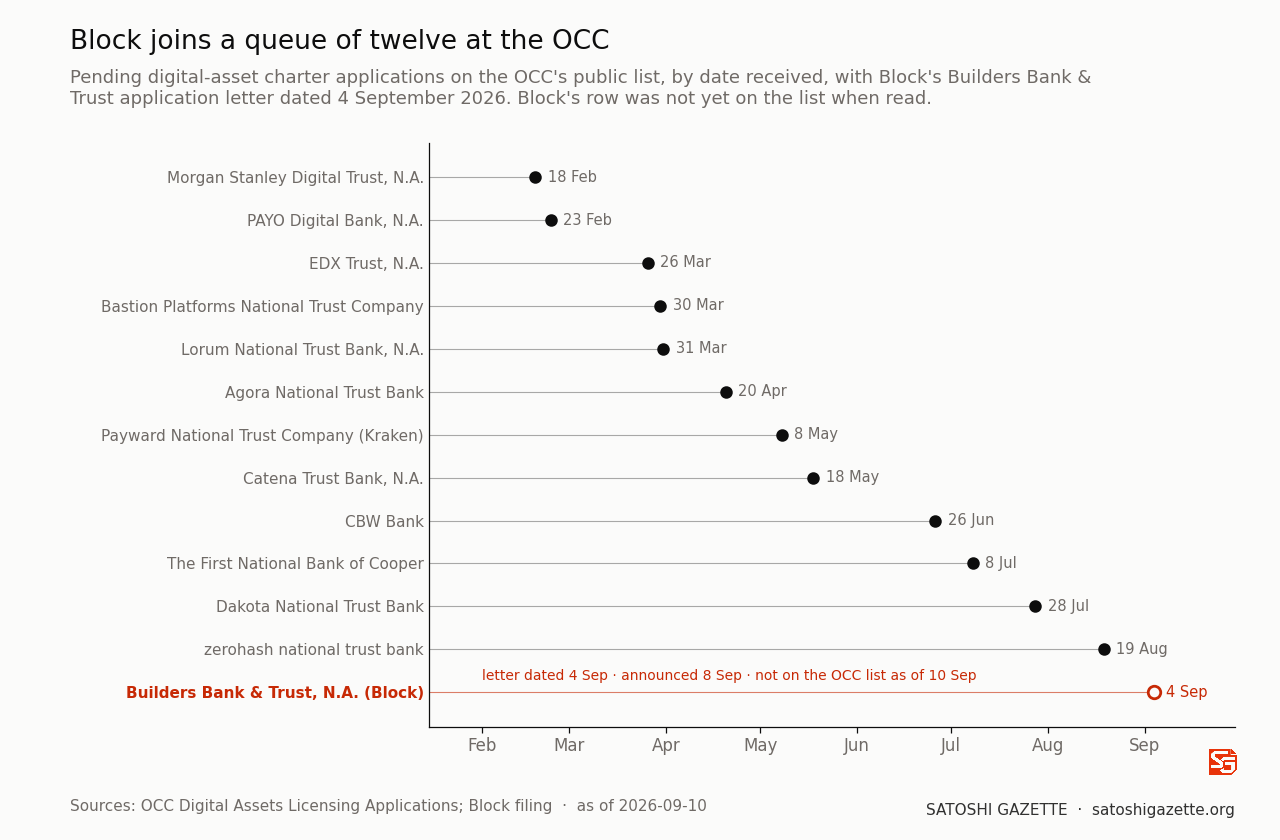
Block is not early. The OCC keeps a public list of pending licensing applications from firms planning to offer digital-asset products, and on 10 September it showed twelve, received between 18 February and 19 August 2026. Morgan Stanley Digital Trust, N.A. and Kraken's Payward National Trust Company are on it. Builders Bank & Trust is not yet; the OCC says a link to an applicant's record appears about five days after receipt and that the list is updated as applications come in.
Method
Twelve rows read from the OCC page's HTML table with commented-out rows excluded; dates are the OCC's 'date received'. Block's date is the transmittal letter date in the public application volume. Drawn with the Gazette's chart module; no values were estimated.
The precedent for what approval looks like is Anchorage. In January 2021 the OCC conditionally approved the conversion of a South Dakota trust company into Anchorage Digital Bank, National Association, and made an operating agreement setting capital and liquidity requirements an enforceable condition. If Builders Bank gets that far, the operating agreement is where the numbers the public volume withholds would start to surface.
Two doors from one company
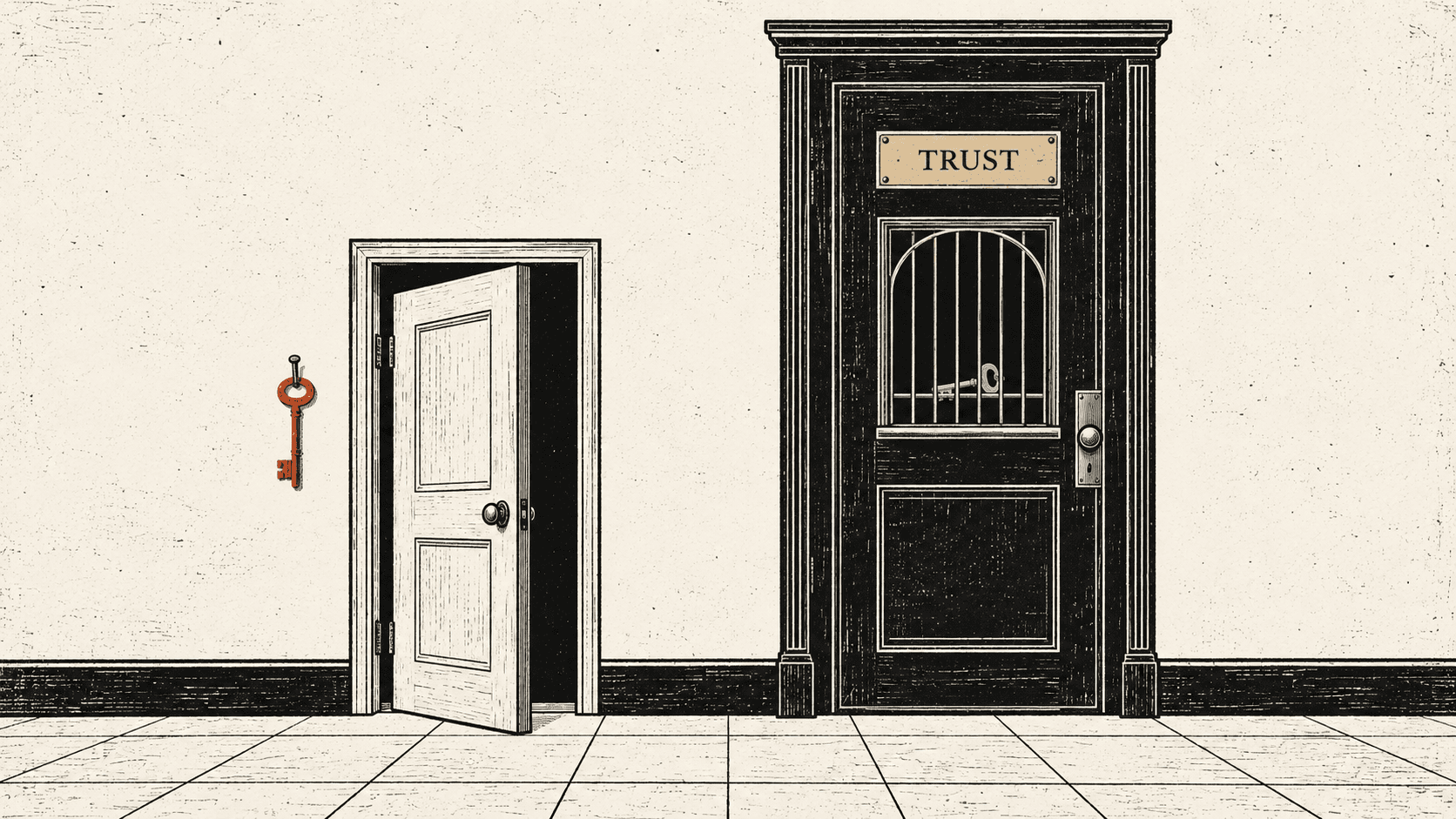
Block's own boilerplate, at the foot of the same press release, describes Bitkey as "a simple self-custody wallet built for bitcoin." The company is now proposing to sell both doors: keys you hold, and keys a federally chartered bank holds for you. There is nothing contradictory in that. It is the honest shape of the market, and a chartered custodian with a fiduciary duty is a different legal animal from a money transmitter with a terms-of-service clause.
But for the two million people a month who buy bitcoin in Cash App, the application changes the supervisor and the legal frame, not the arrangement. Block would still hold the key information. The customer would still be relying on Block. What the holder gains, if anything, will be written in documents that are not yet public: the OCC's version of the application when it posts, any public-comment window, and a conditional-approval operating agreement if one comes. Until then, the only custody terms a Cash App holder can read are the ones in the 10-Q.