What Do You Actually Own?
Bitcoin exposure, redemption rights and personal privacy are different promises. Five investigations show why the distinction matters.
A wallet key, a brokerage balance and a national reserve can all sit beneath the word Bitcoin. They do not give the person looking at them the same rights.
This week, SideSwap said its users retained their keys while its services were paused. A British broker offered Bitcoin exposure without a Bitcoin wallet. A hardware-wallet company's disclosure showed how customer information could remain exposed even when its devices were not compromised.
These are not interchangeable failures. One concerns redemption, another a financial contract, another personal information. But together with our reporting on El Salvador and Russia, they sharpen the question that adoption headlines tend to leave unfinished: what, exactly, has become yours?
The key is yours. The redemption is not.
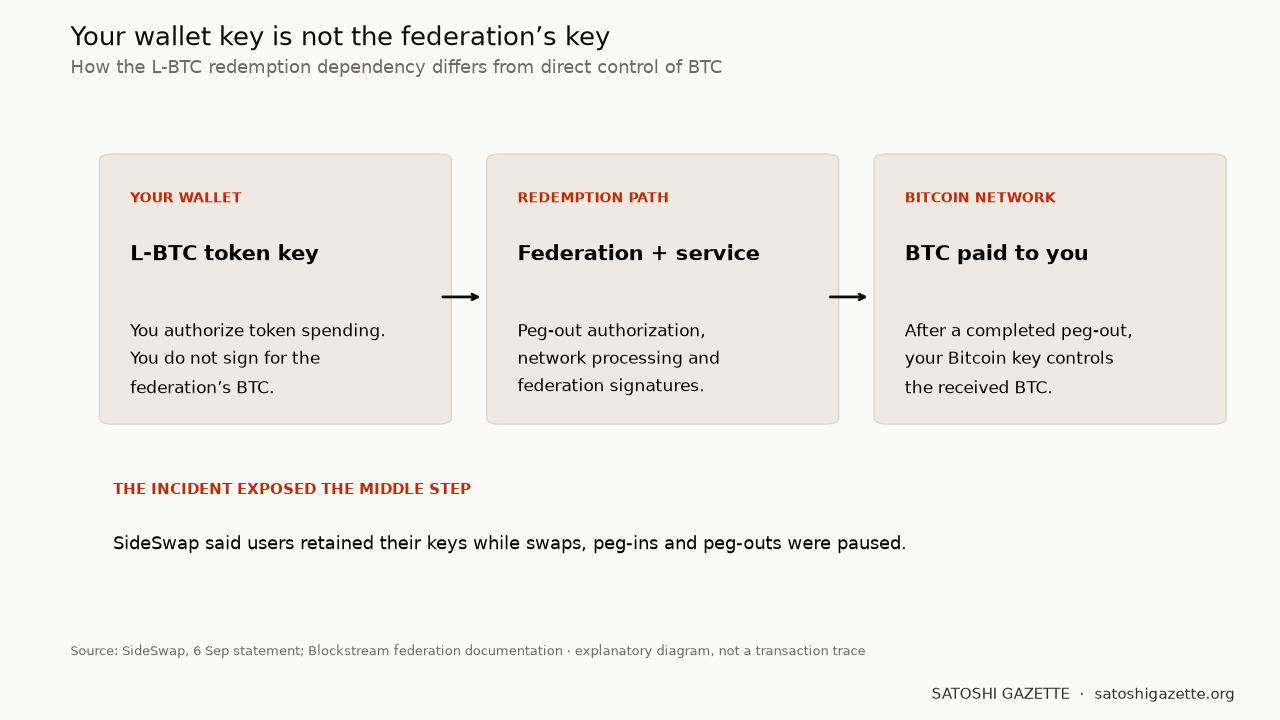
SideSwap's September 6 statement placed two facts side by side: users retained their keys, and swaps, peg-ins and peg-outs were paused. There is no contradiction. An L-BTC key authorizes spending on Liquid; it does not authorize spending the federation's bitcoin on the Bitcoin network.
Method
Conceptual dependency diagram derived from SideSwap’s published pause statement and Blockstream’s description of peg-out authorization and federation signatures. It is not a complete protocol flow or a claim that all ways to sell L-BTC require a peg-out.
That distinction became consequential after a large peg-out. SideSwap attributed the tokens involved to an Elements software bug, not a compromised authorization key. SG did not reproduce the failure. The Bitcoin transactions establish movements of coins, not the software explanation for them.
On September 7, a transaction returned 3,400 BTC to the tracked federation address. That was a substantial return. It did not establish a system-wide reserve position, an agreed bounty or whether holders had been made whole. Our September 8 morning report also recorded Blockstream's statement that updated software had been deployed and a coordinated restart was being prepared. That was a dated operator statement, not our verification of restored service.
The comparison with Hargreaves Lansdown is about the rights involved, not a claim that a regulated security and a sidechain share the same risks. HL's crypto exchange-traded notes give customers a financial instrument rather than cryptocurrency in their own wallet. Selling that instrument on an exchange, seeking delivery from an issuer and signing a Bitcoin transaction are different actions.
The detail matters in both directions. The iShares document reviewed for our Story permits non-authorised-participant investors to request delivery in bitcoin, subject to conditions. Saying securities holders can never obtain bitcoin would therefore be wrong. Calling that provision a tested withdrawal button inside HL would also be wrong.
Convenience can be valuable. A contractual claim can be valuable. Neither needs to be advertised as direct control to justify its existence. The reader deserves to know which route they are buying and which other party must cooperate.
The state has bitcoin. The citizen needs a claim.
The same ownership question changes shape when the account belongs to a government.
El Salvador discloses government-labelled Bitcoin wallets. Our review found no citizen units, pension entitlement or distribution instrument in the public records examined. That does not mean the reserve cannot benefit Salvadorans. Public spending can transmit benefits without giving each citizen a share of an asset. It means those are different arrangements.
The Story's September 6 update preserves another important distinction. The IMF's September 3 statement concerned Chivo's ownership and operating control, customer-asset custody and documented donations. It did not establish a transfer of the national reserve or disclose a citizen-share instrument.
A visible wallet helps a reader inspect coins. It cannot supply the missing legal relationship between the government and a household. For that, publish the beneficiaries, their rights and the rule under which value reaches them.
Russia illustrates a different distinction: permission to invest is not the same as permission to pay. Our September 2 reporting examined the opening for regulated investment and cross-border crypto settlement alongside domestic payment restrictions and the digital-ruble rollout.
The expansion of access matters. So do its limits. It should not be compressed into either “Bitcoin is now ordinary money in Russia” or “nothing changed.” Our reporting also preserved voluntary individual use of the digital ruble and the direct-wallet exception; the details do not support a blanket claim that self-custody was banned.
A state can make Bitcoin more useful to investors or exporters while reserving a different system for everyday payments. The test is the transaction an ordinary person can actually make, not the breadth of the announcement.
The device was secure. The person was exposed.
Trezor's shipping-provider breach brings the argument back to the individual. On September 4, the company disclosed approximately 67,000 additional affected US customers with orders dating from November 2019 to August 2021. It maintained that its systems and devices had not been compromised.
That is a meaningful reassurance about one kind of risk. It does not erase the exposure of names, contact details and shipping addresses. Nor does it answer why records from years earlier were still available to take.
Our Story distinguishes delivery-data deletion commitments from other retention categories and asks what evidence demonstrates that promised deletion actually occurred. A purchase record is not proof of a current Bitcoin balance. It can nevertheless give an impersonator useful context.
Self-custody remains important precisely because it removes a custodian's permission from spending bitcoin. Protecting that freedom also means taking seriously the dependencies around the person using it.
The week's useful test is therefore more demanding than “does this involve Bitcoin?” Identify the asset. Identify what its holder can do without permission. Then ask what happens when the intermediary fails, refuses or changes the rules.
A private key, an enforceable contract and a credible deletion record answer different questions. A serious Bitcoin business should be able to explain which promise it is making and show the evidence that it kept it.